What Is a Healing Modality? A Clear 2026 Guide

Updated: 5 days ago

A healing modality is defined as a specific method, technique, or framework used to address health challenges, support recovery, and improve overall well-being. The term comes from integrative and complementary medicine, where practitioners use it to distinguish one therapeutic approach from another. Modalities range from talk-based therapies like Cognitive Behavioral Therapy (CBT) to somatic methods, energy-focused practices, and whole medical systems like Traditional Chinese Medicine. Understanding what a healing modality is gives you a clearer starting point when the support landscape feels too wide to navigate alone.
Spine App is free: find people who help and a community that gets it. Get it on App Store · Google Play
What are the main types of healing modalities?
Five broad categories of complementary and alternative modalities are widely recognized in integrative medicine: Whole Medical Systems, Mind-Body Medicine, Biologically Based Practices, Manipulative and Body-Based Practices, and Energy Medicine. Each category groups practices by their underlying philosophy and method of action. Knowing these categories helps you compare options without needing a clinical background.

Here is a breakdown of each category with common examples and typical uses:
Category | Examples | Typical Uses |
Whole Medical Systems | Traditional Chinese Medicine, Ayurveda, Homeopathy | Chronic conditions, preventive care, whole-person wellness |
Mind-Body Medicine | Meditation, CBT, Hypnotherapy, Biofeedback | Stress, anxiety, pain management, behavioral change |
Biologically Based Practices | Herbal medicine, nutritional therapy, aromatherapy | Immune support, digestion, energy, hormonal balance |
Manipulative and Body-Based Practices | Chiropractic care, massage therapy, osteopathy | Musculoskeletal pain, mobility, injury recovery |
Energy Medicine | Reiki, acupuncture, therapeutic touch, qigong | Stress reduction, emotional balance, chronic pain |
Integrative medicine combines these categories with conventional care, focusing on the whole person rather than a single symptom. A person managing chronic pain might use chiropractic care alongside CBT and acupuncture, each addressing a different layer of the problem. This combined approach reflects how integrative care works in practice.
The five-category framework is not rigid. Many practitioners draw from multiple categories within a single session. What matters is that each modality has a defined method, a clear intention, and a practitioner trained to apply it.
How do healing modalities work to support recovery?
Healing modalities work through several overlapping mechanisms: physiological changes, mind-body interactions, therapeutic relationship, and shifts in the healing environment. No single mechanism explains all modalities, which is part of what makes this field both rich and complex. Understanding the general principles helps you evaluate options with realistic expectations.
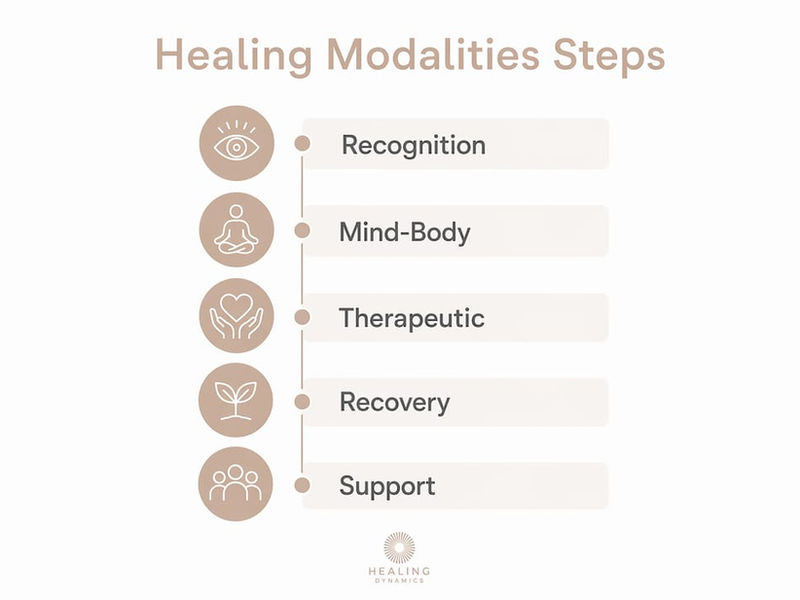
The mind-body connection is central to many alternative healing practices. Practices like meditation and biofeedback train the nervous system to shift out of stress responses, which has measurable effects on heart rate, cortisol levels, and immune function. Somatic therapies work through the body itself, releasing tension stored in muscle and connective tissue. Energy-based methods like Reiki operate on frameworks that mainstream science has not fully validated, yet many people report meaningful relief from them.
The therapeutic relationship and healing environment are central to the success of these approaches. This is a key difference from conventional medicine, which focuses on controlled, singular interventions. Holistic modalities involve many variables, including trust, setting, and the practitioner’s attentiveness, that are harder to measure but genuinely matter.
Key factors that influence how well a modality works include:
Practitioner skill and training: A well-trained practitioner adapts the method to your specific needs.
Client readiness: Your openness and active participation affect outcomes significantly.
Consistency: Most modalities require repeated sessions to produce lasting change.
Integration with other care: Combining modalities with conventional treatment often produces better results than either alone.
For safety and efficacy, therapy and bodywork often complement each other when used together under qualified guidance.
Pro Tip: Before committing to a modality, ask the practitioner how they measure progress and what a realistic timeline looks like. A clear answer signals professional competence.
What are practical examples of popular healing modalities?
Concrete examples make the concept real. The following are among the most widely used modalities, along with what you can expect from a typical session.
Acupuncture: A practitioner inserts fine needles at specific points on the body to influence energy flow and reduce pain. Sessions typically last 30–60 minutes. Some hospitals now use acupuncture for pain management as an alternative to opioids. You may feel mild soreness or fatigue afterward, both of which are normal.
Cognitive Behavioral Therapy (CBT): A talk-based modality that identifies and restructures unhelpful thought patterns. Sessions run 45–60 minutes and typically occur weekly. CBT has strong clinical evidence for anxiety, depression, and chronic pain.
Chiropractic care: A body-based practice that uses manual manipulation of the spine and joints to improve alignment and reduce pain. Sessions last 20–45 minutes. Some people experience temporary soreness after adjustment, which resolves within a day or two.
Reiki: An energy-based practice where a practitioner channels energy through light touch or proximity. Sessions last 45–60 minutes. Evidence is limited, but many people use Reiki for stress reduction and emotional balance alongside other care.
Somatic therapy: A body-centered approach that addresses how trauma and stress are stored physically. Sessions integrate talk with body awareness exercises. Somatic methods are increasingly used alongside conventional psychotherapy for trauma recovery.
Meditation and mindfulness programs: Structured practices that train attention and regulate the nervous system. These range from one-on-one guided sessions to group programs. Body-based practices like mindful movement are particularly effective for stress-related conditions.
Some energy or manipulative therapies can result in temporary physical markers or soreness that are normal and not signs of injury. Cupping, for example, leaves circular marks on the skin that fade within a week. Knowing this in advance prevents unnecessary alarm.
Pro Tip: Ask your practitioner before the first session: “What physical effects should I expect afterward, and when should I be concerned?” A good practitioner will answer this without hesitation.
How to choose the right healing modality for your goals
The most important factor in choosing a modality is your treatment goal and personal preference. The modality itself acts as a method guided by your needs, not the other way around. You do not need to become an expert in every available practice before starting.
A common mistake is “modality shopping,” where someone moves from one practice to another without giving any single approach enough time or depth. Successful outcomes depend more on practitioner skill and client readiness than on the intrinsic qualities of a specific modality. The relationship you build with a practitioner is often the most therapeutic element of the process.
Use these considerations to guide your selection:
Define your primary goal. Are you addressing physical pain, emotional stress, behavioral patterns, or a combination? Different goals point toward different categories.
Consider your comfort with the method. If the idea of needles or physical touch feels wrong, start elsewhere. Comfort supports engagement.
Check practitioner credentials. Look for training, licensing, and experience specific to your concern.
Ask about integration. A qualified practitioner will tell you honestly how their method fits alongside any conventional care you are already receiving.
Start with one modality. Give it at least four to six sessions before evaluating whether it is working.
Revisit your goals regularly. Needs change. A modality that fits now may not be the right fit in six months.
A holistic treatment plan often combines two or three modalities with conventional care, each addressing a different dimension of a health challenge. This integrative approach is not about doing more. It is about doing what fits your situation with the right support in place. Understanding the ethics in holistic practice also helps you identify practitioners who operate with transparency and accountability.
Key Takeaways
A healing modality is a defined therapeutic method, and choosing the right one depends far more on your goals and practitioner fit than on the modality’s reputation alone.
Point | Details |
Clear definition matters | A healing modality is a specific method used to address health challenges, not a vague wellness concept. |
Five recognized categories | Whole Medical Systems, Mind-Body Medicine, Biologically Based Practices, Manipulative, and Energy Medicine cover the full range. |
Relationship drives results | Practitioner skill and client readiness matter more than which modality you choose. |
Post-session effects are normal | Temporary soreness or marks after bodywork are common and not signs of harm. |
Start with your goal | Define what you want to address first, then find a qualified practitioner who works in that area. |
What I have learned from watching people choose modalities
The question I hear most often is not “what modality should I try?” It is “how do I even know where to start?” That confusion is real, and it is not a sign that someone is uninformed. The support landscape is genuinely fragmented, and most people encounter it for the first time when they are already stressed or struggling.
Here is what I have observed consistently: the people who benefit most from alternative healing practices are not the ones who researched every option. They are the ones who found a practitioner they trusted and stayed long enough to notice a change. The modality was almost secondary.
The other thing worth saying plainly is that no single practice is a complete solution. Acupuncture will not replace therapy. Meditation will not fix a structural injury. The most honest practitioners will tell you this themselves. What modalities do well is address dimensions of health that conventional medicine often moves past too quickly: the nervous system, the body’s stored tension, the emotional context of physical symptoms.
My honest advice is to spend less time comparing modalities and more time evaluating the person who will deliver the care. Read their background. Ask them a direct question and notice how they respond. That interaction tells you more than any list of credentials or techniques.
Finding the right support with Spine App
Knowing what a healing modality is and actually finding the right practitioner are two different challenges. Spine App is built for the second one.

Spine App helps you describe what you need in your own words, then matches you with practitioners, sessions, events, and resources across conventional care, alternative practices, or both combined. There is no pressure to commit to one path. You can find your support across three care paths: conventional, alternative, or integrated. Available in 175 countries on iOS, Android, and Web, Spine App gives you a clearer starting point before your first appointment. Visit Spine App to begin your search.
FAQ
What is a healing modality in simple terms?
A healing modality is a specific method or approach used to support health, recovery, or well-being. Examples include acupuncture, CBT, Reiki, chiropractic care, and meditation.
How are healing modalities different from conventional medicine?
Conventional medicine focuses on diagnosing and treating specific conditions through standardized interventions. Healing modalities, particularly alternative healing practices, emphasize the whole person and often address emotional, physical, and energetic dimensions together.
Do I need to choose just one modality?
No. Many people use two or three modalities alongside conventional care, each addressing a different aspect of their health. The key is to work with qualified practitioners and give each approach enough time to show results.
Are healing modalities safe?
Most are safe when delivered by trained practitioners. Some, like cupping or chiropractic adjustment, can cause temporary soreness or visible marks that resolve quickly. Always disclose your full health history to any practitioner before starting.
How do I know if a healing modality is working?
Track your primary goal over four to six sessions. Discuss progress openly with your practitioner. If you see no change and the practitioner cannot explain why, that is useful information too.
Recommended
About Spine App
Spine App is a free life companion app for your health: it connects you with real practitioners – conventional, holistic or both – lets you book sessions directly, and checks in afterwards to ask what helped.
Written by the Spine App Editorial Team.
Spine App is free: find people who help and a community that gets it. Get it on App Store · Google Play