The Role of Body in Emotional Healing: What Science Shows

Updated: 4 days ago

The body is a primary site of emotional healing, not a passive container for feelings. Every emotion you experience registers first as a physical event: a tightening chest, a shift in breath, a change in muscle tone. The field of somatic therapy, which is the recognized clinical term for body-based emotional treatment, has built decades of practice on this fact. Neuroscience now confirms what somatic practitioners have long observed: the body continuously signals the brain, shaping how you feel, how you recover, and how resilient you become. Understanding the role of body in emotional healing is not abstract. It is grounded in biology, and it has direct implications for how you approach your own recovery.
Spine App is free: find people who help and a community that gets it. Get it on App Store · Google Play
What biological mechanisms enable the body to influence emotional healing?
The body-mind connection is not a metaphor. It is a measurable, two-way signaling system with a clear directional bias toward the body leading the conversation.
Approximately 80% of vagus nerve fibers carry sensory signals from the body up to the brain, not the other way around. That ratio matters because it means your brain is largely reacting to what your body reports, not the reverse. When your gut tightens before a difficult conversation, your brain receives that signal and begins constructing an emotional response around it.

Researchers at Washington University School of Medicine identified a structure called the Somato-Cognitive Action Network, or SCAN. SCAN links brain regions that govern thinking with those that control involuntary body functions like heart rate and digestion. This network provides a biological explanation for why changing your breathing pattern can shift your mental state within seconds.
The process of reading your own internal body signals has a clinical name: interoception. Interoception is the brain’s ongoing interpretation of signals from organs, muscles, and tissues. When interoception is well-developed, you can detect emotional shifts earlier, respond more flexibly, and recover faster. When it is underdeveloped, emotions tend to arrive as sudden floods rather than gradual waves.
Key mechanisms at work in the body-brain emotional loop include:
Vagal signaling: The vagus nerve acts as the primary upward channel, carrying gut, heart, and lung data to the brain’s emotional processing centers.
SCAN integration: Thought and involuntary body function share neural real estate, making physical states directly relevant to cognitive and emotional processing.
Interoceptive accuracy: The precision with which you read internal signals predicts how well you regulate emotions under stress.
Nervous system flexibility: A well-regulated nervous system moves between activation and calm without getting stuck. That flexibility is the biological foundation of emotional resilience.
How do somatic and movement therapies harness the body for emotional recovery?
Somatic practices are body-based methods designed to restore nervous system flexibility and improve emotional flow. They work by engaging the body directly rather than relying solely on verbal processing.
Somatic therapy sessions often include 5–10 minutes of active movement, such as shaking or rhythmic swaying, followed by a quiet observation period. That pause after movement is not incidental. It gives the nervous system time to integrate the physical experience and allows emotions to surface and settle without being immediately analyzed.
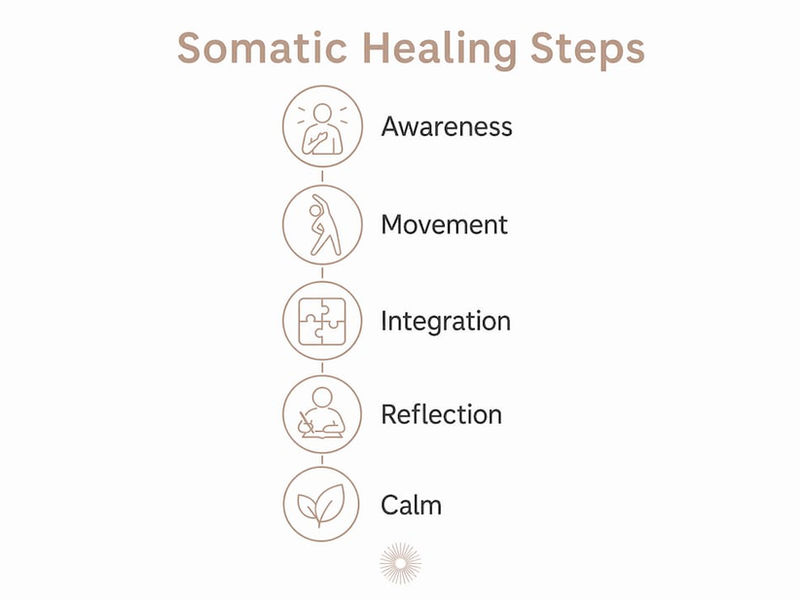
Bilateral, rhythmic movement like walking or running supports nervous system regulation by providing steady, repetitive sensory input that helps complete the stress cycle. This is why a brisk walk after a tense meeting often feels more relieving than sitting and thinking about what happened. The body needs to finish what stress started.
Common somatic and movement-based approaches include:
Shaking and tremoring: Voluntary shaking mimics the natural discharge response animals use after a threat passes. It reduces residual muscular tension linked to unresolved stress.
Breathwork: Controlled breathing directly influences vagal tone, shifting the nervous system toward a calmer state. Slow exhales in particular activate the parasympathetic branch.
Grounding exercises: Pressing feet firmly into the floor or holding a cold object redirects attention to present physical sensation, interrupting anxious thought loops.
Rhythmic walking: A steady walking pace provides the bilateral, repetitive input that helps regulate the nervous system without requiring any verbal processing.
Somatic therapists help people shift learned maladaptive bodily patterns, such as chronic bracing or shallow breathing, that maintain emotional distress long after the original stressor has passed.
Pro Tip: After any movement-based practice, sit quietly for at least five minutes before returning to daily tasks. This observation window is where much of the emotional processing actually happens.
What does the body actually do with emotional experience?
A common misconception frames the body as a storage unit for frozen trauma waiting to be released. The more accurate picture is more dynamic and, ultimately, more hopeful.
Healing involves retraining the nervous system to move fluidly through emotional states rather than simply releasing stored trauma. The body does not hold emotions like files in a cabinet. Instead, it reenacts predictive patterns: learned responses that once protected you but now fire automatically in situations that only partially resemble the original threat.
Consider what this means practically:
Patterns, not storage: The body replays conditioned responses. Healing means updating those predictions, not excavating buried material.
Fluidity as the goal: Emotional health is not the absence of difficult feelings. It is the ability to move through them without getting stuck.
Micro-signals as early warnings: Subtle physical signals such as muscle tightening or shallow breathing often signal distress before conscious awareness. Catching these early gives you more options for response.
Initial intensification is normal: When people begin body-based emotional work, feelings sometimes get louder before they settle. This is not a sign that something is wrong. It reflects the nervous system beginning to process what it had previously bypassed.
“Learning to safely feel emotions in the body restores natural emotional flow rather than encouraging intellectual avoidance.” — Psychotherapy Networker
Somatic awareness enables noticing inner bodily sensations, which improves emotional regulation and nervous system balance over time. The body becomes less of a source of alarm and more of a reliable source of information.
How can you practically build body awareness for emotional healing?
Developing somatic awareness does not require a clinical setting to begin. Small, consistent practices build the internal sensitivity that supports emotional recovery over time.
Early and subtle bodily micro-signals provide crucial information for emotional self-regulation and early intervention. Learning to notice them is a skill, and like any skill, it improves with deliberate attention.
Practical starting points include:
Posture check-ins: Several times a day, pause and notice where you are holding tension. Shoulders, jaw, and hands are common sites. Simply noticing without trying to fix anything begins to build interoceptive accuracy.
Breath observation: Before reacting to a stressful situation, take three slow breaths and notice what changes in your body. This creates a small gap between stimulus and response.
Rhythmic walking with attention: Walk at a steady pace and focus on the alternating sensation of feet contacting the ground. This combines bilateral movement with present-moment body awareness.
Shaking practice: Stand and allow your knees to bounce gently for two to three minutes. Follow with stillness and observe what arises without judgment.
For a broader framework on managing stress through body-based approaches, the holistic support for chronic stress guide offers practical context.
Knowing when to seek professional support matters as much as the practices themselves. If body-based work surfaces intense emotions, memories, or physical discomfort that feels unmanageable, a trained somatic therapist provides the skilled containment needed to navigate that safely. The types of practitioners for integrative wellness vary widely, and matching the right professional to your specific situation makes a significant difference in outcomes.
Pro Tip: Keep a brief body journal for one week. After each emotional event, write two sentences about where you felt it physically and how intense the sensation was. This practice builds interoceptive vocabulary faster than most formal exercises.
Key takeaways
The body is an active participant in emotional healing, not a secondary system. Engaging it directly through somatic awareness and movement produces changes that verbal processing alone cannot reliably achieve.
Point | Details |
Body leads the brain | 80% of vagus nerve signals travel upward, meaning physical states shape emotional experience more than most people realize. |
SCAN connects thought and body | The Somato-Cognitive Action Network links thinking and involuntary body functions, making physical practices directly relevant to emotional states. |
Healing is retraining, not releasing | The nervous system learns new patterns rather than excavating stored emotions; fluidity is the goal. |
Micro-signals are early data | Subtle cues like shallow breathing or muscle tension appear before conscious distress and offer an early window for intervention. |
Movement completes the stress cycle | Bilateral rhythmic movement like walking helps the nervous system finish what stress started, reducing residual tension. |
What I have learned from paying attention to the body first
Most people come to emotional healing through their thoughts. They analyze, they talk, they try to reframe. That approach has real value. But I have noticed, again and again, that the people who make the deepest shifts are the ones who learn to listen to their bodies before they reach for an explanation.
The body does not lie in the way the mind sometimes does. It does not rationalize or minimize. A tight throat during a conversation you claim is fine tells you something your words will not. Learning to trust those signals, rather than override them, is one of the most underrated skills in emotional recovery.
What I find most encouraging about the neuroscience is that it removes the shame from struggle. Your nervous system is doing exactly what it learned to do. The work is not about willpower or insight alone. It is about gradually teaching your body that new responses are possible.
That process takes patience. It also takes honest, nonjudgmental attention. And for many people, it takes skilled support at key moments, not because they are broken, but because some emotional terrain is genuinely difficult to cross alone. A dual approach to healing that combines body-based and conventional care often produces the most durable results.
Finding the right support for body-based emotional healing
Knowing that the body plays a central role in emotional recovery is one thing. Finding the right practitioner to guide that process is another challenge entirely.

Spine App helps you find practitioners, sessions, and resources matched to your specific situation before your first appointment. Whether you are drawn to conventional therapy, somatic and holistic care, or a combination of both, Spine App guides you through all three paths without pressure or a single fixed ideology. You describe what you need in your own words, and Spine surfaces options that fit. Available in 175 countries on iOS, Android, and Web, Spine App makes it easier to find the right kind of support for the work your body and mind are ready to do.
FAQ
What is the role of body in emotional healing?
The body continuously signals the brain through pathways like the vagus nerve, shaping emotional states and nervous system regulation. Engaging the body directly through somatic practices accelerates emotional recovery in ways that verbal processing alone cannot.
What are somatic practices for healing?
Somatic practices are body-based methods including breathwork, shaking, grounding exercises, and rhythmic movement that restore nervous system flexibility and improve emotional flow. Sessions often include 5–10 minutes of active movement followed by quiet observation to allow integration.
How does movement support emotional recovery?
Bilateral, rhythmic movement like walking or running provides steady sensory input that helps complete the stress cycle and regulate the nervous system. This is why physical activity often relieves emotional tension more effectively than thinking through a problem.
Can body-based work make emotions feel more intense at first?
Yes. When people begin somatic work, feelings sometimes intensify before they settle. This reflects the nervous system beginning to process what it previously bypassed, and skilled support helps navigate that phase safely.
How do I know which type of practitioner to seek for somatic support?
Somatic therapists specialize in shifting learned bodily patterns that maintain emotional distress. If you are unsure whether conventional therapy, somatic care, or a combined approach fits your situation, Spine App can help you identify the right match before your first appointment.
Recommended
About Spine App
Spine App is a free life companion app for your health: it connects you with real practitioners – conventional, holistic or both – lets you book sessions directly, and checks in afterwards to ask what helped.
Written by the Spine App Editorial Team.
Spine App is free: find people who help and a community that gets it. Get it on App Store · Google Play