What Is a Dual Approach to Healing?

Updated: 4 days ago

A dual approach to healing is defined as the coordinated use of conventional biomedical medicine alongside evidence-based complementary therapies to treat the whole person, not just isolated symptoms. This model, increasingly adopted by major hospital systems and endorsed by the World Health Organization’s 2025–2034 Traditional Medicine Strategy, is the recognized clinical term for what many people call integrative medicine. If you are facing a chronic condition, a mental health challenge, or the aftermath of trauma, understanding this approach can change how you think about your options and who you ask for help.
Spine App is free: find people who help and a community that gets it. Get it on App Store · Google Play
What is a dual approach to healing, and how does it work?
A dual approach to healing, formally called integrative medicine, combines treatments like medication, surgery, and diagnostics with complementary methods such as acupuncture, massage, meditation, nutrition therapy, and yoga. The goal is not to replace one with the other. The goal is to address what conventional medicine sometimes misses: the emotional, psychological, and relational dimensions of illness.
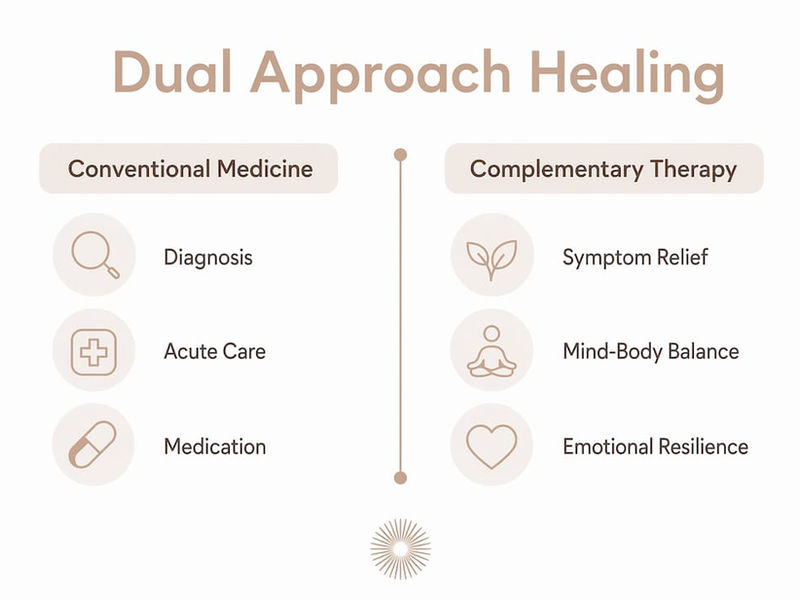
Conventional medicine excels at diagnosis and acute intervention. A cardiologist can stabilize a heart condition; a psychiatrist can prescribe medication that lifts a depressive episode. What these treatments often do not address is why the body stays stuck in stress, or why emotional pain resurfaces after the crisis passes. Complementary therapies fill that gap by working on the nervous system, the breath, the body’s tension patterns, and the mind’s relationship to pain.
A practical example: a person managing fibromyalgia might receive medication from a rheumatologist while also attending weekly acupuncture sessions and a mindfulness-based stress reduction program. Each treatment targets a different layer of the condition. Together, they produce outcomes that neither approach achieves alone.

Dimension | Conventional medicine | Complementary therapy |
Primary focus | Diagnosis and symptom reduction | Whole-person balance and regulation |
Common methods | Medication, surgery, imaging | Acupuncture, massage, meditation, nutrition |
Strength | Evidence-based, fast-acting | Addresses emotional and nervous system roots |
Limitation | Can overlook emotional or lifestyle factors | Varies in evidence base by modality |
Best used for | Acute illness, chronic disease management | Stress, trauma, recovery support, prevention |
What are the benefits of dual healing?
Integrative medicine improves quality of life for people living with chronic pain, cancer side effects, fibromyalgia, and mental health conditions by addressing physical, emotional, and psychological health at the same time. The WHO frames this as “people-centered” care, a model that avoids the fragmented treatment that leaves many people feeling like they fell through the cracks.
The evidence for specific outcomes is growing. Studies on cancer patients using integrative care alongside chemotherapy show reduced anxiety, better sleep, and lower reported pain. People recovering from trauma benefit when somatic therapies are added to talk therapy, because trauma lives in the body as much as in memory. Dual approaches break harmful feedback loops between the mind, the nervous system, and physical symptoms, which is why treating only one layer often produces only partial relief.
Emotional resilience is another measurable gain. People who engage in mind-body healing practices alongside conventional treatment report a stronger sense of agency over their health. That sense of agency matters. It reduces the helplessness that often accompanies chronic illness and makes people more consistent with all their treatments, conventional and complementary alike.
Pro Tip: Most people start integrative care too late, after conventional treatment has stalled. The research suggests better outcomes when complementary therapies are introduced early, not as a last resort.
For people dealing with chronic stress, the combination of nervous system regulation through bodywork and psychological support through therapy or coaching is particularly effective.
How do you start a dual approach safely?
The first step is a conversation with your primary care provider. This is not optional. Patients must consult their doctor before starting complementary therapies because some modalities interact with medications or are contraindicated for certain conditions. Acupuncture, for example, requires caution if you are on blood thinners. Certain herbal supplements affect how the liver processes prescription drugs.
Full disclosure to every practitioner is equally non-negotiable. Non-disclosure risks unsafe interactions that can alter drug efficacy and create new health problems. Your acupuncturist needs to know what your psychiatrist has prescribed. Your massage therapist needs to know about your recent surgery. The system only works when information flows freely between everyone involved in your care.
Finding credentialed providers is the next practical step. Not all complementary practitioners carry equivalent training. Look for practitioners licensed by recognized professional bodies: licensed acupuncturists, certified massage therapists, registered dietitians, and yoga therapists certified through the International Association of Yoga Therapists. Spine’s guide on spotting trustworthy providers is a useful starting point for evaluating credentials.
Practical first steps for starting a dual approach:
Talk to your primary care provider and describe the complementary therapies you are considering.
Ask your doctor for referrals to integrative practitioners within or affiliated with your existing care network.
Research credentials for any complementary provider before booking a session.
Keep a shared record of all treatments, supplements, and sessions to share with every practitioner.
Set a realistic timeline. Sessions typically run 30–90 minutes over at least 4–6 weeks before meaningful changes become apparent.
Check your insurance coverage. Coverage for complementary therapies varies widely and is often inconsistent.
Common dual healing techniques and what they target
Dual healing techniques work because they address different biological and psychological systems at the same time. Acupuncture combined with bodywork like tuina targets both physical pain pathways and the autonomic nervous system. Mindfulness-based cognitive therapy paired with antidepressant medication addresses both the neurochemical and the cognitive dimensions of depression. Neither pairing is redundant. Each modality reaches a layer the other cannot.
Practitioners sequence dual-modality sessions by starting with calming techniques first. This induces a parasympathetic state, which makes the nervous system more receptive to deeper structural or psychological work. A session might begin with guided breathing or light massage before moving into acupuncture or somatic processing. Combined sessions can be more tiring than single-modality appointments, so rest afterward is part of the protocol, not optional recovery.
Technique | Primary focus | What it addresses |
Acupuncture + bodywork | Physical pain and nervous system | Chronic pain, inflammation, tension patterns |
Mindfulness + medication | Cognitive and neurochemical | Depression, anxiety, stress response |
Nutrition therapy + conventional care | Metabolic and systemic | Chronic illness, energy, immune function |
Somatic therapy + talk therapy | Body memory and cognition | Trauma, PTSD, emotional dysregulation |
Yoga + physical rehabilitation | Movement and breath | Recovery, mobility, stress reduction |
Understanding when to choose therapy, coaching, or holistic support helps you build a combination that fits your actual situation rather than a generic template. The right mix depends on your diagnosis, your history, and what your body and mind are ready to work on.
Complementary medicine offered alongside conventional care is increasingly included in medical school curricula, which signals a shift in how the mainstream health system views these methods. This is not fringe territory anymore.
Key Takeaways
A dual approach to healing produces better outcomes than either conventional or complementary care alone because it treats the physical, emotional, and psychological dimensions of illness at the same time.
Point | Details |
Core definition | Integrative medicine combines biomedical treatment with evidence-based complementary therapies. |
Safety first | Always disclose all treatments to every practitioner to avoid unsafe interactions. |
Sequence matters | Start sessions with calming techniques to prepare the nervous system for deeper work. |
Timeline is realistic | Expect 4–6 weeks of consistent sessions before noticing meaningful change. |
Credentials count | Choose licensed, credentialed complementary practitioners to ensure safety and effectiveness. |
What I have learned from watching people navigate this
The biggest mistake I see is treating the dual approach as a fallback. People exhaust conventional options, feel let down, and then turn to complementary care as a last resort. By that point, they are often depleted, skeptical, and harder to reach. The research and the clinical experience both point in the same direction: integration works best when it starts early, not after everything else has failed.
The second thing I have noticed is how much fear surrounds this topic. Some people worry that choosing a holistic method means abandoning evidence-based care. Others feel judged by their doctors for wanting something beyond a prescription. Both fears are understandable, and both are largely outdated. The WHO’s endorsement of integrative approaches and the growing presence of these methods in hospital systems reflect a genuine shift in how medicine understands healing.
What actually changes when someone commits to a dual approach is their relationship to their own body. They stop waiting to be fixed and start participating in their recovery. That shift in orientation, from passive patient to active participant, is often where the real turning point happens. It is not magic. It is coordination, disclosure, and showing up consistently for both sides of the equation.
The confusion about where to start is real, though. The support landscape is fragmented, and most people do not have a guide who knows both worlds. That is the gap worth closing.
— Rosa
Finding the right support across both paths
Knowing that a dual approach makes sense is one thing. Finding the right practitioners to make it work is another challenge entirely.

](www.spine.app)
Spine is a platform built for exactly this situation. It helps people find therapists, coaches, and complementary care providers across conventional, holistic, and combined care paths, before the first appointment. You describe what you are dealing with in plain language, and Spine matches you with credentialed practitioners, sessions, and resources suited to your needs. No single ideology, no pressure toward one path. Available in 175 countries on iOS, Android, and web, Spine gives you a clearer starting point in a space that is usually too scattered to navigate alone. Find the right support for your situation today.
FAQ
What is a dual approach to healing?
A dual approach to healing, clinically called integrative medicine, combines conventional biomedical treatments with evidence-based complementary therapies to address the whole person. Major institutions including the WHO and Mayo Clinic recognize this model as effective for chronic conditions, mental health, and recovery.
Is integrative medicine safe to use with conventional treatment?
Integrative medicine is safe when all practitioners are fully informed about every treatment and supplement you are using. Consulting your primary care provider before starting any complementary therapy is the essential first step.
How long does a dual healing approach take to show results?
Most people notice meaningful changes after 4–6 weeks of consistent sessions combining conventional and complementary care. Session lengths typically run 30–90 minutes depending on the modalities involved.
What conditions benefit most from complementary healing approaches?
Chronic pain, fibromyalgia, cancer side effects, trauma, and mental health conditions like depression and anxiety show the strongest evidence for benefit from integrative care. The WHO identifies these as priority areas for integrative medicine.
How do I find credentialed practitioners for both types of care?
Look for practitioners licensed by recognized professional bodies: licensed acupuncturists, certified massage therapists, registered dietitians, and yoga therapists certified through the International Association of Yoga Therapists. Spine’s guide on identifying trustworthy providers outlines what credentials to look for and what questions to ask.
Recommended
About Spine App
Spine App is a free life companion app for your health: it connects you with real practitioners – conventional, holistic or both – lets you book sessions directly, and checks in afterwards to ask what helped.
Written by the Spine App Editorial Team.
Spine App is free: find people who help and a community that gets it. Get it on App Store · Google Play