The Role of Ethics in Holistic Practice: A Clear Guide

Updated: 4 days ago

Ethics in holistic practice is defined as the moral framework that governs how practitioners treat clients, communicate their limits, and protect trust across every session. Without this framework, even well-meaning care can cause harm. The role of ethics in holistic practice covers everything from how a Reiki practitioner explains what a session can and cannot do, to how an Ayurvedic counselor handles a client’s private health history. Professional bodies like the National Association of Holistic Health Practitioners (NAHHP) and the American Alternative Medical Association (AAMA) have codified these standards precisely because good intentions are not enough. What follows is a clear, honest look at the principles, tensions, and practical realities that shape ethical care in this field.
Spine App is free: find people who help and a community that gets it. Get it on App Store · Google Play
What are the core ethical principles that govern holistic practice?
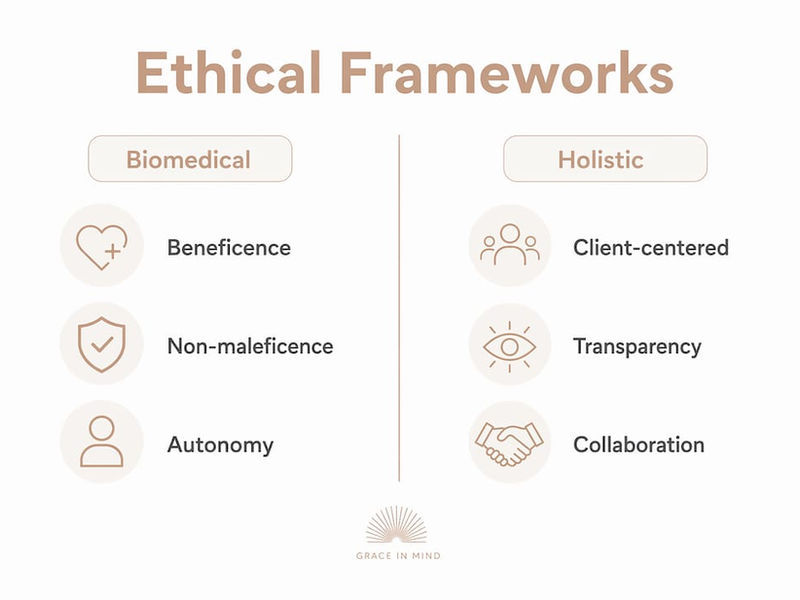
Five principles form the ethical backbone of responsible holistic care: beneficence, non-maleficence, autonomy, confidentiality, and scope of practice.

Beneficence means actively working in the client’s best interest. In holistic care, this goes beyond recommending a treatment. It means selecting approaches that fit the individual’s full context, including their culture, values, and existing medical care.
Non-maleficence is the commitment to avoid harm. A practitioner who recommends high-dose herbal supplements without checking for drug interactions violates this principle, even if the intent is helpful.
Autonomy: Clients have the right to make informed decisions about their care. The NAHHP Code of Ethics requires practitioners to respect client choices, even when those choices differ from the practitioner’s recommendation.
Confidentiality: Client information stays private. This applies to session notes, health histories, and any personal disclosures made during treatment.
Professional boundaries: Practitioners must stay within their training and credentials. Referring a client to a physician, psychologist, or specialist is not a failure. It is an ethical obligation.
Honesty about qualifications: Misrepresenting training or certifications is an ethical violation, not just a legal risk. Clients deserve to know exactly who is treating them and what that person is qualified to do.
Pro Tip: Before your first session with any holistic practitioner, ask directly: “What are the limits of what you can treat, and when would you refer me elsewhere?” An ethical practitioner will answer this question clearly and without defensiveness.
The AAMA Standards of Practice reinforce that collaboration and transparency are not optional extras. They are the floor of ethical complementary medicine. A practitioner who cannot name the boundaries of their practice is a practitioner worth approaching with caution.
How do ethical frameworks differ across holistic and biomedical traditions?
The most common mistake in integrative care is assuming that traditions share the same ethical vocabulary. They do not. A concept like beneficence means something different in evidence-based biomedicine than it does in Traditional Chinese Medicine (TCM) or Ayurveda.
In biomedicine, beneficence is typically measured by population-level outcomes and clinical trial data. In TCM or Ayurvedic practice, beneficence centers on restoring individual harmony, which may not map onto measurable biomarkers at all. The BMJ Medical Ethics blog describes this as a “bifurcation in beneficence.” It means two practitioners can both claim to act ethically while recommending opposite courses of action.
Ethical concept | Biomedical interpretation | Holistic/traditional interpretation |
Beneficence | Evidence-based, population outcomes | Individualized harmony and balance |
Informed consent | Standardized disclosure form | Ongoing relational conversation |
Scope of practice | Defined by licensure and specialty | Defined by training lineage and tradition |
Risk communication | Statistical probability | Contextual and energetic assessment |
This table is not a ranking. Neither approach is automatically superior. The problem arises when practitioners from different traditions assume alignment without actually checking. Cross-tradition clinical ethics requires interprofessional dialogue that names these divergences openly rather than papering over them.
Epistemic overreach is a specific risk here. This happens when a practitioner implies certainty that goes beyond what their tradition can actually demonstrate. The credibility challenges facing holistic medicine often trace back to this exact failure: practitioners who cannot clearly say where their knowledge ends. Ethical practice means naming that boundary, not hiding it.
What are the practical ethical challenges holistic practitioners face today?
Real-world ethical challenges in holistic care are less abstract than textbooks suggest. They show up in everyday decisions about money, referrals, and client relationships.
Commercialization pressure is one of the most underacknowledged risks. When practitioners sell supplements, courses, or products alongside their services, the financial incentive can quietly distort clinical judgment. The Journal of Ayurveda and Integrated Medical Sciences identifies commercialization as a direct threat to transparency, patient autonomy, and ecological responsibility in holistic traditions. Awareness of this pressure is the first step toward managing it.
Scope violations: A massage therapist who begins offering nutritional diagnoses, or a Reiki practitioner who advises a client to stop psychiatric medication, has crossed an ethical line. Scope violations are not always dramatic. They often happen gradually, through small overreaches that accumulate over time.
Informed consent in practice: A 2026 BMC Medical Ethics study found that genuine informed consent in herbal medicine trials requires more than a signed form. Clients need real comprehension support, especially when cultural expectations or power dynamics make it hard to ask questions.
Integrative oncology: Up to 70% of cancer patients use complementary therapies alongside conventional treatment. This creates serious ethical obligations around communication, safety screening, and timely referrals. A holistic practitioner working with oncology clients who does not coordinate with the medical team is creating a safety gap.
Relational dynamics: The therapeutic relationship in holistic care is often more intimate than in conventional medicine. That closeness is part of what makes it effective. It also creates conditions where boundary violations are easier to rationalize.
Pro Tip: If you are a practitioner, document your referral decisions. A written record of when and why you referred a client to another provider is both an ethical safeguard and a professional protection.
The safeguarding standards developed for practices like Reiki and Tarot reading make this concrete: clear policies, transparent qualifications, and accountable care structures protect both the client and the practitioner. These are not bureaucratic formalities. They are the infrastructure of trust.
How can holistic practitioners apply ethics to build client trust?
Ethics in daily practice is less about knowing the principles and more about applying them consistently, especially when it is inconvenient.
Practice active, ongoing consent. Consent is not a one-time event at intake. Relational consent in holistic care must be continuous, allowing clients to modify or withdraw participation at any point. Check in regularly. Make it easy for clients to say no or to change direction.
Communicate treatment limits clearly. Tell clients what a session can realistically offer and what it cannot. If you practice acupuncture, explain what the evidence supports and where the evidence is limited. Clients who understand the realistic scope of a treatment are better positioned to make good decisions.
Be transparent about your qualifications. List your training, certifications, and any professional memberships. Clients who know exactly who they are working with can give genuinely informed consent. Vague or inflated credentials are an ethical failure before the first session begins.
Refer when the situation exceeds your scope. Knowing when to refer a client to a therapist, physician, or specialist is a sign of competence, not weakness. The AAMA Standards of Practice treat appropriate referral as a core ethical obligation.
Consider cultural and ecological responsibility. Treatment choices carry broader implications. Recommending endangered plant medicines, or ignoring a client’s cultural context when designing a care plan, are ethical oversights that affect more than the individual session.
Commit to ongoing ethical education. Ethics is not a box checked during initial training. Professional standards evolve, and practitioners who stay current are better equipped to protect their clients and themselves. Knowing how to spot trustworthy providers is as useful for practitioners as it is for clients.
The importance of ethics in wellness is both moral and practical. Practitioners who operate with transparency and accountability build the kind of trust that sustains a practice over years, not just months.
Key Takeaways
Ethics in holistic practice is not a set of rules imposed from outside. It is the foundation that makes genuine care possible.
Point | Details |
Core principles matter | Beneficence, non-maleficence, autonomy, confidentiality, and scope define ethical holistic care. |
Traditions differ ethically | Biomedical and holistic traditions interpret concepts like beneficence differently; name the gap openly. |
Consent is ongoing | Ethical consent is a continuous conversation, not a form signed at intake. |
Scope limits protect everyone | Referring clients beyond your training is an obligation, not an admission of failure. |
Transparency builds trust | Clear communication about qualifications and treatment limits is the foundation of credible practice. |
Ethics as a living practice, not a checklist
I have spent years watching practitioners in both conventional and alternative settings struggle with the same tension: they entered this work because they genuinely want to help, and then they discover that good intentions create their own blind spots.
The hardest ethical failures I have seen are not the obvious ones. They are the practitioner who slowly expanded their scope because clients kept asking. The one who stopped disclosing limitations because clients seemed to prefer certainty. The one who added a product line and gradually stopped noticing when the sales pitch crept into clinical advice. These are not bad people. They are people who stopped treating ethics as a living practice and started treating it as a credential they already earned.
What I find most honest about the current state of holistic care is that the field is under real pressure. Commercialization, the explosion of online practitioners, and the lack of universal regulation have made it genuinely harder to maintain standards. The credibility challenges in holistic medicine are real, and they are not solved by defensive posturing. They are solved by practitioners who are willing to say, clearly and publicly, where their knowledge ends.
Humility is not a soft skill in this context. It is the most rigorous ethical stance available. A practitioner who can say “I don’t know, and here is who might” is more trustworthy than one who always has an answer. Ongoing ethical education, peer accountability, and genuine interprofessional dialogue are not optional for practitioners who want to be part of a credible field. They are the work.
— Rosa
Finding ethical holistic care that fits your situation
Knowing the principles is one thing. Finding a practitioner who actually lives by them is another challenge entirely.

](www.spine.app)
Spine is an AI-powered platform that helps you find therapists, coaches, and holistic practitioners before your first appointment. You describe what you need in your own words, and Spine matches you with providers across conventional care, holistic and alternative care, or both. No pressure toward any single approach. No diagnosis. Just clearer orientation in a space that is usually too fragmented to navigate alone. Whether you are looking for an acupuncturist, a somatic coach, or an integrative health counselor, Spine helps you find vetted practitioners who are transparent about their qualifications and scope. Available in 175 countries, on iOS, Android, and Web.
FAQ
What is the role of ethics in holistic practice?
Ethics in holistic practice defines the moral standards that govern how practitioners treat clients, communicate their limits, and maintain trust. Core principles include beneficence, non-maleficence, autonomy, confidentiality, and scope-bounded care.
Why does informed consent matter more in holistic care?
Informed consent in holistic care requires genuine client comprehension, not just a signed form. Power dynamics, cultural expectations, and unfamiliar treatment concepts make active, ongoing consent especially important in this context.
How do I know if a holistic practitioner is operating ethically?
An ethical practitioner clearly states their qualifications, explains what their treatment can and cannot do, and refers you to other providers when your needs exceed their scope. Vague credentials or guaranteed outcomes are warning signs.
What is epistemic overreach in holistic medicine?
Epistemic overreach happens when a practitioner implies certainty beyond what their training or evidence supports. Ethical practice requires naming the limits of knowledge and encouraging clients to ask questions and seek second opinions.
How does ethics differ across holistic and conventional medical traditions?
Biomedical ethics typically relies on population-level evidence and standardized disclosure. Holistic traditions often center on individualized harmony and relational consent. Ethical integration requires naming these differences openly rather than assuming shared values.
Recommended
About Spine App
Spine App is a free life companion app for your health: it connects you with real practitioners – conventional, holistic or both – lets you book sessions directly, and checks in afterwards to ask what helped.
Written by the Spine App Editorial Team.
Spine App is free: find people who help and a community that gets it. Get it on App Store · Google Play