
Coaches: Validate Your Offer With a $15 a Day Ad and a 90 Day Funnel

Updated: Oct 5

Get your niche and one offer clear before you spend a dollar on ads: pick a single discovery offer, build one landing page around it, and promote it through no more than two channels, usually organic content plus one paid channel. A platform like Spine App can be part of that channel mix as a discoverability option, not a replacement for it. Fewer choices, tested in sequence, convert better than a dozen half-built campaigns running at once.
TL;DR:
Focusing on a single offer and promoting it through organic content plus one small paid channel yields better results than multiple fragmented campaigns.
Search ads work best when prospects have clear buying intent and your landing page has a conversion rate of 6 to 8 percent, significantly higher than generic pages.
Building a simple, targeted funnel with matching headlines and minimal form fields increases conversions and avoids frustrating prospects with options overload.
Content marketing and relationship-building through consistent publishing lower customer acquisition costs over time, outperforming ads in the long run.
Using platforms like Spine App can enhance discoverability by profiling audiences searching for support, reducing dependence on paid keyword campaigns.
Spine App is free: find people who help and a community that gets it. Get it on App Store · Google Play
Table of Contents
Which Channels Actually Get Coaching Clients Online?
Every channel promises reach. Few of them match how coaching clients actually buy. The trick isn’t picking the “best” platform, it’s matching the channel to where your prospect already is in their decision.
Search (Google Ads) captures people who already know they need help and are typing the words “life coach” or “executive coaching” into a search bar right now. This is buying intent, not browsing. A focused coaching landing page can convert at 6 to 8 percent, compared with 1 to 2 percent for a generic homepage, which tells you the landing page matters more than the platform.
Meta ads (Facebook and Instagram) work differently. They interrupt, so they’re best for accelerating an offer you’ve already validated with organic traffic, not for testing a brand-new idea cold.
LinkedIn earns its keep with executive coaching, leadership coaching, or B2B niches where the client’s job title is the qualifier.
YouTube and organic social build trust before the sale happens, which matters enormously in coaching where people are buying a relationship, not a product.
Email and webinars close warm leads who need one more nudge and a specific date.
Quick selection rules that save money:
Use Search when your niche has clear “buying intent” keywords people actively search.
Use Meta only after your funnel has converted organic traffic at a decent rate.
Use LinkedIn for corporate or executive coaching, skip it for general life coaching.
Test with a small budget for two weeks before committing real spend.
Never launch paid ads before your funnel has proof it converts organically.
How Do You Build a Funnel That Turns Clicks Into Calls?
A funnel is really just one message repeated three times: the ad, the landing page, and the call to action. Break that chain anywhere and you lose the prospect.
Match your ad headline to your landing page headline. If the ad says “Stop Overworking Without Burning Out,” your landing page needs that exact phrase in its headline, not a rebrand.
Give the page one job. One outcome, one testimonial block, one call to action. No navigation menu, no three competing offers.
Map your lead magnet to the right next step. A free assessment feeds into an email nurture sequence that ends in a discovery call. A webinar feeds directly into group program enrollment. A mini-course feeds into a paid tier.
Embed your scheduler on the page itself. Every extra click between “interested” and “booked” costs you conversions.
Keep your form to three fields. Name, email, and one qualifying question, nothing more.
Pro Tip: Run your own funnel through it as a stranger would. If you can’t find the booking button in five seconds, neither can your prospect.
What Budget and Targeting Actually Work for Paid Ads?
Coaches waste money on ads mostly by skipping structure. Separate campaigns by intent instead of lumping everything into one: a brand campaign for people searching your name, a high-intent services campaign for people searching your niche plus “coach,” and a local campaign if you serve a geographic area. Inside each campaign, keep ad groups single-theme, one service or outcome per group, so your ad copy stays specific instead of generic.
On Meta, creative is the real targeting lever now. The algorithm needs a minimum volume of conversions to exit its learning phase, so daily budgets under $10 rarely produce usable data.
Start with a daily budget generally recommended in the range of low double digits for the first two weeks.
Scale winning ads by no more than 20 percent every 48 hours, never double overnight.
Track booked calls as your primary event, not clicks or landing page views.
For your benchmark, treat 6 to 8 percent landing page conversion and 20 to 40 percent call-to-close on qualified leads as the range worth aiming for. Anything meaningfully below that points to a funnel problem, not an ad problem.
Why Content and Relationships Still Outperform Ads Long-Term

Ads accelerate. Content compounds. A blog post or YouTube video from two years ago can still be pulling in leads today, something no ad campaign does once you stop paying for it. SEO and consistent publishing lower your cost of acquisition over time in a way paid channels can’t replicate on their own.
The cadence matters more than the platform:
One YouTube video per week, even a short one, beats ten videos posted in a single burst then silence.
Three to five LinkedIn posts weekly keeps you visible to the algorithm and to people scrolling during their commute.
One long-form blog post monthly gives search engines something substantial to index.
Your email sequence should move new subscribers through four stages: a welcome message, a nurture series that builds trust, a conversion email tied to your offer, and a long-term follow-up for people who weren’t ready yet. Podcast guesting and speaking slots let you borrow someone else’s audience, often faster than building your own from zero.
How Do You Stop Overwhelming Prospects With Too Many Options?
Psychologists call it choice overload: the more options a person faces, the harder it becomes to decide, and the less satisfied they feel with whatever they eventually pick. This shows up constantly in health and wellbeing searches. Someone looking for support after a diagnosis, a breakup, or months of exhaustion doesn’t need twelve program tiers. They need one clear next step.
Offer two or three packages, never more. Each one should describe an outcome, not a list of features.
Build a micro-decision flow. Ask one qualifying question at a time instead of a long intake form up front.
Place one testimonial per package, tied to the specific outcome that package promises, not a generic quote.
Pro Tip: Run an A/B test with three tiers against a single test with one tier. If bookings rise and cancellation rates drop, you’ve found your real answer, not a theoretical one.
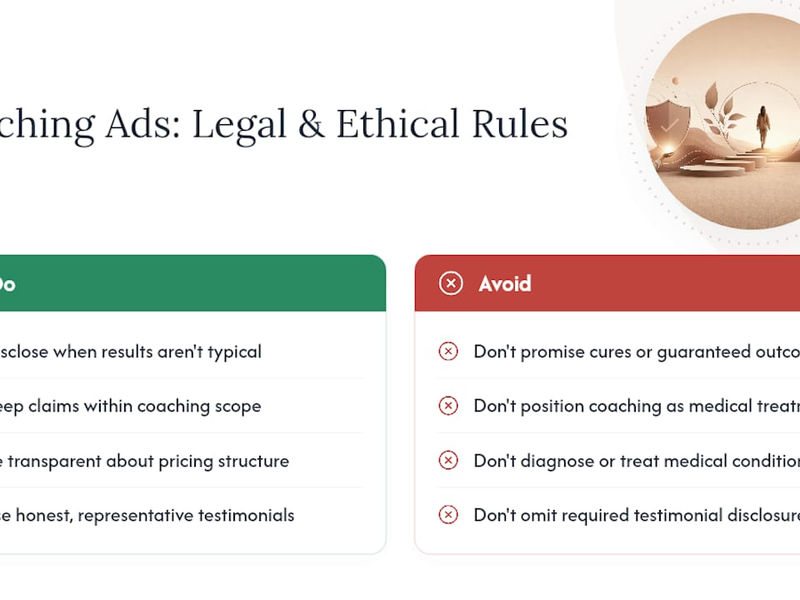
What Are the Legal and Ethical Rules for Coaching Ads?
Coaching is largely unregulated compared with licensed therapy or medicine, which makes ethical restraint your responsibility rather than a legal requirement someone else enforces. That gap is exactly where trouble starts.
Never advertise coaching as a substitute for mental health treatment, and never promise a specific health or psychological outcome your program can’t guarantee. Phrases like “cure your anxiety” or “heal your trauma” cross from coaching into clinical territory, and in the United States, that language can trigger scrutiny from the Federal Trade Commission over deceptive advertising claims, whether or not you’re licensed to make them.
Testimonials need honesty, too. If a client’s result was unusual, say so, rather than implying it’s typical. The FTC’s endorsement guidelines require clear disclosure when a testimonial doesn’t represent a typical result, and coaching pages routinely skip that disclosure.
If your niche touches nutrition, trauma, or medical history, know where your scope ends. A health coach can discuss habits and mindset; diagnosing or treating a condition belongs to a licensed provider. Blurring that line in your ad copy isn’t just risky, it can mislead someone who genuinely needs different support than you’re equipped to give.
Finally, be transparent about pricing structure in your marketing when you can. Vague “book a call for pricing” pages create the same decision fatigue we covered above, and they erode trust before the conversation even starts.
A 90-Day Sequence for a Busy Coach
Weeks 1 to 4: nail your niche and build one landing page. Check nothing yet, just build. Weeks 5 to 8: publish consistently and start a small paid test, $15 a day, tracking bookings weekly. Weeks 9 to 12: scale what converts, drop what doesn’t. When time is tight, protect the funnel work over new channels. Simplifying your client’s choice always beats adding another filter.
— Sylvia
Get Discovered Without Another Ad Campaign to Manage
Platforms like Spine App give coaches a place where people searching for support, conventional, holistic, or a mix of both, can find profiles without bidding on keywords. You host a profile, list sessions or events, and appear in searches from people who search by what they are dealing with rather than by your service name.

Treat your profile like another landing page in your funnel. List an upcoming webinar or discovery-call offer the same way you would on your own site, using outcome language your ideal client would actually type. Many coaches building visibility this way also fix related issues on their own listings across other directories, since the same clarity problems show up everywhere prospects search. If you want a low-effort test of demand before committing more budget elsewhere, create or update your Spine App profile and run one small promotional listing this month.
Sources
For paid search benchmarks and landing page conversion rates, see Scale Growth Digital’s guide to Google Ads for coaches. For Meta campaign structure and testing budgets, see the Meta Ads guide for coaches and freelancers. For funnel sequencing philosophy, see Trainerize’s guide to marketing a coaching business. For email and content structure, see Lovepixel Agency’s coaching marketing guide.
FAQ
What’s the fastest way to advertise coaching services online?
Build one landing page around a single offer, then drive traffic to it through organic content and one small paid test, rather than launching several channels at once.
Should I start with paid ads or organic content?
Start with organic content to validate your offer and funnel, then use paid ads as an accelerator once you know the message converts.
How much should I budget for my first coaching ad campaign?
Start with a daily budget generally recommended in the range of low double digits for the first two weeks, then scale winning ads by no more than 20 percent every 48 hours.
What conversion rate should my coaching landing page hit?
Well-built coaching landing pages typically convert at 6 to 8 percent, compared with 1 to 2 percent for a generic homepage.
How many pricing packages should I offer prospects?
Stick to two or three tiers with clear outcomes attached to each; more options tend to increase decision fatigue and lower booking rates.
Can Spine App help me get discovered without running ads?
Yes, a Spine App profile lets people already searching for coaching support, conventional or holistic, find you through descriptive search rather than paid keywords.
What legal issues should I watch for in coaching ads?
Avoid language that implies you treat mental health conditions, disclose when testimonials describe unusual rather than typical results, and stay clear about pricing.
Recommended
Download Spine App now:
Android: Get it on Google Play
About Spine App
Spine App is a free life companion app for your health: it connects you with real practitioners – conventional, holistic or both – lets you book sessions directly, and checks in afterwards to ask what helped.
Written by the Spine App Editorial Team.
Spine App is free: find people who help and a community that gets it. Get it on App Store · Google Play
