
Write Trauma Aware Wellness Event Descriptions for Hosts: Fill Seats

Updated: Oct 5

The pattern that works for nearly any wellness event is short: name the benefit, name who it’s for, name the outcome, then tell them exactly how to register. A one-sentence version might read: “A 90-minute breathwork session for anyone running on empty, so you leave with one tool you’ll actually use again, spots open now at our platform.” It converts because it removes guesswork. Readers decide in about five seconds whether an event is for them, and vague copy loses that window every time.
TL;DR:
Clear, benefit-led headlines and specific outcomes increase registration by focusing on participant results and measurable skills.
Including detailed logistics and accessibility information at the top of descriptions helps reduce questions and barriers for a diverse audience.
Using minute-by-minute agendas for workshops or detailed schedules for retreats makes events feel manageable and sets clear expectations.
Promoting events with early-bird deadlines, testimonials, and visible registration links boosts sign-up rates and engagement.
Descriptions should match the audience’s familiarity level, using plain language for general attendees and technical framing only when appropriate.
Spine App is free: find people who help and a community that gets it. Get it on App Store · Google Play
Table of Contents
Wellness Event Description Examples Across Different Formats
The best wellness event descriptions change shape depending on format, but they never lose the core elements: a scene, a clear “who,” a list of what happens, an outcome, and logistics. Below are six formats organizers ask about most, each built around a different modality from the daily rotation, so you can see how tone shifts without losing clarity.
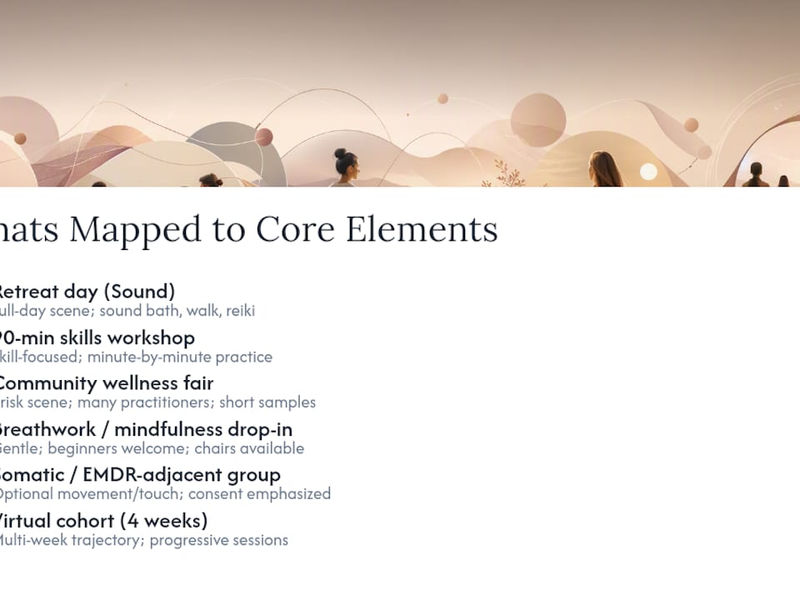
Retreat-style day event (Sound Healing). Retreat copy earns its length by making the day feel tangible, not abstract. “Spend a full day resetting your nervous system alongside others who are just as tired of running on fumes. Morning sound bath at 9 AM, forest walk at 11, afternoon Reiki stations, and a closing gong meditation at 4 PM. Bring a mat, a journal, and nothing to prove.” Schedule blocks like this, borrowed from how retreat listings structure a day’s agenda, make an eight-hour event feel manageable instead of overwhelming.
90-minute skills workshop (Cognitive Behavioral Therapy basics). Workshop copy should promise a specific, teachable skill, not a vague feeling. “Learn three CBT reframing techniques you can use the next time anxious thoughts spiral, in 90 minutes flat. 6:00 to 6:20: naming the thought pattern. 6:20 to 7:00: practicing reframes in pairs. 7:00 to 7:30: building your personal script.” Minute-by-minute breakdowns like this one, aligned with how Cornell’s guidance on measurable learning outcomes frames workshop planning, tell attendees exactly what they’re paying for.
Community wellness fair (mixed modalities). Fair copy stays brisk. “Twenty local practitioners, one afternoon. Try a free 15-minute chair massage, sample an Ayurvedic tea blend, or sit in on a mini functional medicine talk. No registration needed, just show up.” Exhibitor lists work better than adjectives here.
Breathwork or mindfulness drop-in. Drop-in sessions need clear expectations about intensity. “A gentle, guided breathwork session for beginners and regulars alike. No experience needed, no lying on the floor required if that’s not your thing, chairs available throughout.” Naming who it is not for (advanced practitioners looking for intensity) is as useful as naming who it’s for.
Somatic Experiencing or EMDR-adjacent session. This is where language needs the most care. “A trauma-aware Somatic Experiencing group for people who feel like their body holds onto stress longer than it should. All movement is optional, all touch is opt-in and explained beforehand, and a private space is available if you need to step out.” Consent phrasing like this matters more here than almost any other event type.
Virtual cohort or series (Health Coaching). Series copy should promise a trajectory across sessions, not just one hour. “Four weeks, four live sessions, one small group. Week one builds your baseline, week four sends you home with a plan you’ll still be using in six months.” Naming what changes from week to week keeps a series from feeling like four disconnected webinars.
Copy Snippets You Can Mix and Match
Building a description from scratch takes longer than editing one together from proven pieces. Use these modular lines as a starting kit.
Headline formulas. Benefit-led: “Sleep Better in One Session.” Audience-led: “For Anyone Who Says ‘I’m Fine’ More Than They Mean It.” Curiosity-led: “The 20-Minute Practice Therapists Keep Recommending.”
Hook lines. State the “why” in one sentence: “This session exists because most people wait until burnout to ask for help, and this gets you there sooner.”
Logistics checklist. Date, time, duration, location (or platform link for virtual), what to bring, price, and a direct registration link. Missing even one of these tends to generate the same repeated question in your inbox.
Accessibility and food phrasing. “This venue is wheelchair accessible with an accessible restroom on-site. Snacks provided are nut-free and vegan; let us know of other needs when you register.” More than 24% of adults report a disability and over 10% manage a food allergy, according to CDC data, so specifics here aren’t optional extras.
Pro Tip: Write your accessibility line before you write your headline. It forces you to confirm the venue actually works for the audience you’re describing, instead of bolting on a disclaimer later.
How to Adapt Tone by Modality and Audience
Plain language works when the goal is broad appeal. “A gentle stretching class for tired bodies” beats “a Yoga Therapy intervention for musculoskeletal restoration” nine times out of ten, unless your audience already speaks in clinical or modality-specific terms and expects it.
For clinical-adjacent modalities like Functional Medicine or Osteopathy, naming the mechanism (“we’ll map how sleep, stress, and digestion connect”) builds trust with a skeptical audience.
For holistic modalities like Craniosacral Therapy or Family Constellation, naming the felt experience (“you’ll notice a settling in your body”) lands better than technical framing.
Somatic and EMDR-adjacent events need explicit consent language: what touch means, that movement is optional, and where a private space exists if someone needs to step away.
Beginner copy should say “no experience needed” directly; experienced-practitioner copy can reference prior training or depth of practice without over-explaining basics.
Hands-on treatments (Massage Therapy, Acupuncture) need a line about draping, hygiene, or needle safety; classroom-style workshops (Health Coaching, CBT) need a line about materials or takeaway worksheets instead.
Promotion Tactics That Match Your Description
Promotion works best when it echoes the exact benefit your description already promises, not a separate marketing voice.
Pull your description’s outcome line straight into your subject line and social caption, so the promise stays identical everywhere it appears.
Add one short testimonial or attendance number near the registration button. Even “12 people joined last month’s session” functions as proof.
Use early-bird pricing with a real deadline, not an evergreen “limited spots” line that never expires.
Run a free 20 to 30 minute teaser session to warm up leads before the paid event, a tactic workshop marketing guides consistently point to for lowering signup friction.
Keep your registration link visible without scrolling, and confirm payment takes three clicks or fewer.
Leave your event page live after the date passes; attendees often revisit a page multiple times before committing.
When “I’m Fine” Stops Working
“I’m fine” often isn’t denial. It’s a genuinely useful strategy for getting through a hard stretch: deadlines, a diagnosis, a loss, a season where stopping to feel everything isn’t an option. That’s not weakness. It’s often the only tool available at the time.
The quiet signs it’s starting to cost more than it gives usually show up small: sleep that doesn’t restore anymore, patience running thinner than it used to, saying “fine” to end a conversation rather than to answer it honestly. Event copy can meet people there without pressure. A line like “for anyone who’s been saying ‘I’m fine’ longer than they mean it” invites without diagnosing, and leaves the choice entirely with the reader.
— Sylvia
Where to List Your Event or Find One Near You
Writing a strong description solves half the problem. The other half is getting it in front of people who are actually looking, and that’s where a lot of solid events quietly underperform. Our platform gives hosts a place to list wellness events alongside practitioner profiles and reviews, so attendees searching for a specific modality, whether that’s Reiki, Somatic Experiencing, or Health Coaching, can find your event the same way they’d find a provider.

Place your registration link and accessibility details near the top of your listing, the same way this article recommends structuring the description itself. If you host sessions regularly, browsing the Spine App podcast and platform page is a reasonable next step to see how events sit alongside providers and community content. If you’re the one searching rather than hosting, the same listing space works for finding a session near you or online, worldwide.
Sources
For more on structure and conversion, see Eventbrite’s guide to writing event descriptions, Jazmin Hupp’s breakdown of the 13 elements in retreat marketing copy, and Cornell’s Bloom’s Taxonomy resource for writing measurable outcomes. For promotion sequencing, Maven’s workshop marketing guide covers teaser sessions and email funnels in more depth.
Bloom’s Taxonomy (Cornell Teaching resources)
FAQ
What makes a wellness event description convert?
A clear benefit-led headline, a hook that states the participant’s reason to attend, specific logistics, and a direct call to action all matter more than polished language.
How long should a workshop description be?
Most platforms cap workshop summaries around 750 words, but the strongest descriptions say what they need in far less, saving detail for a schedule breakdown rather than dense paragraphs.
Should I list accessibility details even for small events?
Yes. Over 24% of adults report a disability, according to CDC data, so stating venue accessibility and food accommodations directly prevents lost registrations from unanswered questions.
How do I write for trauma-aware sessions like Somatic Experiencing?
State plainly that movement and touch are optional, explain what physical contact might involve before the session, and offer a way to ask questions ahead of time.
What’s a good way to price a wellness workshop?
Early-bird pricing with a firm deadline tends to convert better than a vague “limited spots” line, since a real deadline gives people a reason to decide now rather than later.
Can Spine App help me find wellness events near me?
Spine App lists events and practitioner profiles across conventional and holistic modalities, so you can search by what you need rather than by category alone.
How do I know if my event description is too vague?
If a reader can’t tell within one sentence who the event is for and what they’ll walk away with, the description needs more specificity, not more length.
Recommended
Download Spine App now:
Android: Get it on Google Play
About Spine App
Spine App is a free life companion app for your health: it connects you with real practitioners – conventional, holistic or both – lets you book sessions directly, and checks in afterwards to ask what helped.
Written by the Spine App Editorial Team.
Spine App is free: find people who help and a community that gets it. Get it on App Store · Google Play
