
What Is a Niche in Therapy Practice: A Practical Guide

Updated: Oct 5

A therapy niche is a defined focus area — a specific population, clinical problem, or treatment approach — that shapes how you position, market, and deliver your private practice. The short verdict: choosing a niche makes you easier to find, easier to refer, and more effective with the clients you serve best.
Three reasons this matters right now:
Marketing clarity. A focused message cuts through noise faster than a generalist one, making you memorable to both clients and referral partners.
Better clinical fit. When your caseload reflects your training and genuine interest, session quality tends to rise and outcomes improve.
Sustainable workload. Seeing clients whose presentations align with your strengths reduces the kind of chronic depletion that drives burnout.
Spine App is free: find people who help and a community that gets it. Get it on App Store · Google Play
Key Takeaways
A therapy niche is the single most practical lever for building a private practice that is both clinically rewarding and financially sustainable.
Point | Details |
Define before you market | A niche is a specific population, problem, or approach — not just a credential or a broad specialty label. |
Ethics set the floor | The ACA Code of Ethics requires practicing within competence; advertising a niche implies you can deliver it. |
Pilot before committing | Run an 8–12 week test: update one profile, track four signals, and review after 10–15 niche-aligned clients. |
Data accelerates clarity | Tracking 5 intake and outcome fields every 15 clients reveals your most viable niche faster than self-reflection alone. |
Spine App | List a focused service on Spine App to generate real demand signals and reach clients already searching for your niche. |
Table of Contents
What is a niche in therapy practice, and why does it differ from just “picking a specialty”?
Common therapy niches you can actually build a practice around
How a niche differs from an ideal client, and why you need both
Common mistakes that slow niche development or damage credibility
How practitioner platforms and client data can speed up niche discovery
Spine App helps practitioners reach the clients who need them most
What is a niche in therapy practice, and why does it differ from just “picking a specialty”?
The term specialty usually refers to a clinical credential or formal training track, like being a licensed marriage and family therapist or a certified EMDR practitioner. A niche is something more specific and more strategic: it is the intersection of what you do well, who you most want to serve, and where genuine demand exists in your market.
A generalist practice says, “I see adults, couples, and teens.” A niche practice says, “I work with first-generation college students navigating identity and anxiety.” Both are valid. The second one, however, gives a potential client or a referring physician an immediate, clear picture of whether you are the right fit.
The ACA Code of Ethics adds an important constraint: therapists must practice within their scope of competence and make appropriate referrals when a client’s needs fall outside it. Naming a niche is not just a marketing decision. It is also an ethical commitment to having the training and experience to back up what you advertise.
Why defining a niche matters for a U.S. private practice
Niching changes how clients and referrers perceive you, often within weeks of updating your messaging. The practical effects are concrete.
Referral memorability. A pediatrician who knows you specialize in childhood anxiety will think of you the moment a parent mentions school refusal. A generalist therapist rarely gets that automatic recall.
Rate premium. Specialized care commands higher fees. Clients seeking a specific kind of help are often willing to pay more for someone who demonstrably knows their situation.
Faster caseload growth. Consistent positioning makes therapists more memorable to referral partners, which accelerates how quickly a caseload fills, according to research on professional identity and marketing.
Reduced burnout risk. Seeing clients whose presentations genuinely interest you is protective. Chronic mismatch between a clinician’s strengths and their caseload is one of the quieter drivers of attrition in the field.
The HRSA Behavioral Health Workforce Brief documents uneven geographic distribution and specialty shortages across the U.S. behavioral health workforce. That gap is an opportunity: a well-defined niche in an underserved area or population can fill a real need while building a financially viable practice.
Statistic to know: The JAMA Network Open 2023 analysis highlights persistent disparities in mental health access across populations and regions, which is part of why niches like perinatal care, rural telehealth, and LGBTQ+ affirming therapy show consistently high demand.
Pro Tip: Change one line on your website’s homepage — replace “I work with adults experiencing a range of concerns” with a sentence naming your focus population and presenting problem. Track inquiry volume and quality for four weeks. That single edit often produces a measurable shift before you change anything else.
Common therapy niches you can actually build a practice around
The list below is organized by category. Each entry names the client and the typical presenting concern. Sub-niches appear in italics where the category is broad enough to warrant them.
Population-based niches
Perinatal mental health — pregnant and postpartum clients experiencing depression, anxiety, or birth trauma. Sub-niche: perinatal OCD.
Adolescents and teens — identity development, academic pressure, social anxiety, self-harm.
Older adults — grief, life transitions, cognitive concerns, caregiver stress.
LGBTQ+ affirming therapy — identity exploration, minority stress, family rejection, relationship concerns.
First-generation college students — cultural identity conflict, academic anxiety, family pressure.
Veterans and active-duty military — PTSD, moral injury, reintegration challenges.
Immigrant and bicultural clients — acculturation stress, intergenerational conflict, language barriers.
Clinical problem-based niches
Trauma and PTSD — single-incident trauma, complex developmental trauma, first responder trauma.
Anxiety disorders — generalized anxiety, panic disorder, health anxiety, social anxiety.
OCD and related disorders — contamination fears, intrusive thoughts, body-focused repetitive behaviors.
Eating disorders — anorexia, bulimia, binge eating, ARFID.
Grief and bereavement — sudden loss, anticipatory grief, complicated grief.
Chronic illness and pain — adjustment to diagnosis, illness anxiety, caregiver burnout.
Relationship and attachment issues — couples in distress, attachment trauma, infidelity recovery.
Substance use and recovery — co-occurring disorders, harm reduction, family systems work.
Modality or approach-based niches
EMDR-focused practice — trauma processing using Eye Movement Desensitization and Reprocessing.
Somatic therapy — body-based approaches for trauma, anxiety, and chronic stress.
Mindfulness-based therapy — MBSR, MBCT, ACT-informed work for depression and anxiety.
Internal Family Systems (IFS) — parts-based work for trauma, self-criticism, and relational patterns.
Setting or delivery-based niches
Telehealth-only practice — serving clients statewide, often in rural or underserved areas. The Rural Health Information Hub documents persistent access gaps that make this niche both needed and viable.
Intensive outpatient support — clients stepping down from higher levels of care.
School-based or college counseling consultation — working alongside educational systems.
Research in clinical psychology consistently finds that targeted interventions and trained specialists tend to achieve better treatment matching for specific disorders, which is the clinical case for choosing a niche rather than staying broad.
Pro Tip: Think of your first niche as a one-year experiment, not a lifetime label. Picking a near-term test niche — one that overlaps with your current caseload — lets you gather real data before committing to rebranding or additional training.

How a niche differs from an ideal client, and why you need both
A niche is your positioning: the focus area you advertise, the population or problem you specialize in. An ideal client is a deeper persona: the specific person within that niche whose situation, values, and readiness for change align best with how you work.
Niche shapes your website copy, your Psychology Today profile, your referral conversations.
Ideal client shapes your intake questions, your session structure, and your sense of who you do your best work with.
A worked example: your niche is anxiety in high-achieving women. Your ideal client is a woman in her 30s or 40s, professionally successful, who has never been in therapy before, tends to intellectualize, and is motivated by concrete tools rather than open-ended exploration. That level of specificity does not narrow your marketing — it sharpens it. Your intake form, your website tone, and your session pacing all become more coherent.
The ACA Code of Ethics is worth keeping in mind here: advertising a niche implies competence. If your ideal client description includes a clinical presentation you are not trained to treat, that is a referral situation, not a marketing opportunity.
Step-by-step exercises to identify your therapy niche
Each step below takes roughly 10–20 minutes and produces a concrete output you can use in the next step.
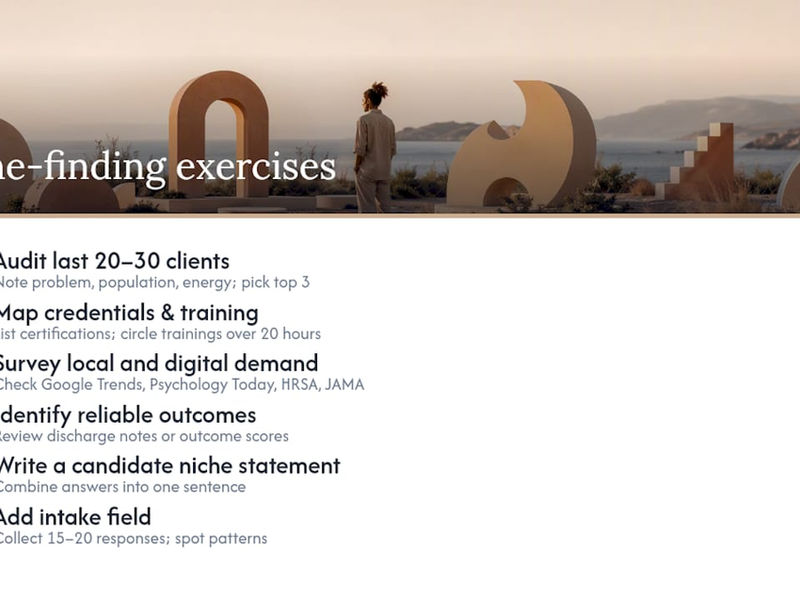
Step 1: Audit your last 20–30 clients. Pull your caseload notes or intake records. For each client, note the presenting problem, the population, and your honest energy level during sessions. Which cases felt most alive? Which felt like a grind? The pattern is usually visible within 10 minutes.
Worksheet prompt: “Of my last 25 clients, which three sessions did I look forward to most? What did those clients have in common?”
Step 2: Map your credentials and training. List every certification, CE course, supervision focus, and clinical training you have completed. Circle the ones that took you more than 20 hours to complete. Those represent real depth, and depth is what makes a niche credible. Research on training and workforce implications shows that training investment varies widely across specialty tracks, which directly affects how quickly you can credibly market a niche.
Worksheet prompt: “Which of my credentials would a referring provider find most reassuring when sending a specific type of client?”
Step 3: Survey local and digital demand. Check Google Trends for your metro area, review Psychology Today’s filter options, and look at the HRSA Behavioral Health Workforce Brief for your state’s shortage areas. Cross-reference with the JAMA Network Open analysis on access disparities to identify populations with unmet need.
Worksheet prompt: “Is there a population in my area that is underserved and that I have some training or experience with?”
Step 4: Identify the outcomes you deliver most reliably. Review your discharge notes or outcome measure scores if you track them. Which client groups show the clearest improvement? Consistent outcomes in a specific area are a strong signal that you have a natural niche, even if you have not named it yet. ASHA research on specialized training illustrates why credential signals matter: clients and referrers respond to demonstrated, trackable results.
Worksheet prompt: “Which presenting problem do I feel most confident explaining to a new client in plain language?”
Step 5: Write a candidate niche statement. Combine your answers into one sentence: “I specialize in [presenting problem or population] using [approach or modality], particularly for [specific context or life stage].”
Example: “I specialize in anxiety and perfectionism in early-career professionals using ACT and somatic approaches, particularly for clients navigating major life transitions.”
Pro Tip: If you use an EHR, add a custom intake field asking clients how they found you and what specific concern brought them in. After 15–20 responses, patterns emerge that no amount of self-reflection can replicate.
How to test and refine your niche before fully committing
A niche pilot does not require a website overhaul. Start with three low-effort changes and measure what shifts.
Weeks 1–2: Update one surface. Rewrite the first sentence of your Psychology Today profile or website bio to name your niche. Send one brief email to two or three referral partners explaining your focus. Add one intake question: “What specific concern brought you to seek therapy now?”
Weeks 3–8: Track four signals.
Signal | What to measure | How often |
Inquiry volume | Number of new contact form submissions or calls | Weekly |
Referral source | Which referrers are sending niche-aligned clients | Bi-weekly |
Session retention | Average number of sessions before discharge | Monthly |
Outcome indicators | Simple symptom measure (PHQ-9, GAD-7) at intake and week 6 | Per client |
Weeks 9–12: Review and decide. After 10–15 niche-aligned inquiries, ask: Are these clients a good fit? Are referrers responding? Are outcomes tracking in the right direction? JMIR Formative Research found that digital tracking of outcomes and client characteristics supports iterative service design — meaning the data you collect during a pilot is itself a clinical tool, not just a marketing exercise.
Common pilot questions:
How many clients before I can decide? Ten to fifteen niche-aligned clients gives a workable signal. Fewer than that is anecdote, not pattern.
What if inquiries drop? A short-term dip is normal when messaging shifts. If it persists past eight weeks, the niche statement may need adjustment, not abandonment.
Do I need to turn away non-niche clients? No. A pilot niche means you are testing positioning, not closing your practice to everyone else.
Implementation checklist:
Update one public-facing profile with the niche statement.
Add one intake question targeting the niche population.
Email two referral partners with a one-sentence description of your focus.
Set up a simple tracking sheet (or EHR tag) for niche-aligned clients.
Schedule a 12-week review date before you start.
For guidance on which marketing channels deliver the best return when testing niche messaging, paid search and SEO tend to produce the clearest signal fastest for private-practice therapists.
Common mistakes that slow niche development or damage credibility
Most niche problems fall into a handful of predictable patterns. Knowing them in advance saves months of wasted effort.
Choosing a niche with no local or digital demand. Passion alone does not fill a caseload. Always cross-reference your interest with workforce data and search trends before committing.
Using clinical jargon in marketing copy. “I specialize in complex developmental trauma using polyvagal-informed EMDR” means something to a colleague, almost nothing to a client searching online. Translate clinical language into the words your clients actually use.
Ignoring your referral network. A niche that your existing referrers cannot describe or remember will not generate referrals. Test your niche statement on a non-therapist friend. If they cannot repeat it back in one sentence, simplify it.
Advertising a niche before building the competence. The ACA Code of Ethics is explicit: marketing a specialty implies you can deliver it. Advertising a niche you are still learning is an ethics risk, not just a credibility one.
Going too narrow too fast. “Anxiety in left-handed female architects over 40” is not a niche; it is a demographic curiosity. A workable niche needs enough potential clients to sustain a caseload.
Red flags that your pilot niche is not working:
Fewer than five niche-aligned inquiries after eight weeks of updated messaging.
Referrers cannot describe your focus when you ask them.
You feel less energized by niche-aligned sessions than by your general caseload.
Outcome measures show no improvement trend after 10–12 clients.
Pro Tip: If a niche is not generating traction after 12 weeks, widen the aperture by one step before abandoning it entirely. “Perinatal anxiety” that is not filling may work better as “anxiety in women during major life transitions.” Your core clinical strength stays intact; the positioning just gets a little more room.
Two short case vignettes: niche development in practice
Vignette 1: From generalist to perinatal specialist
A licensed clinical social worker with five years of general adult practice noticed that her most energized sessions were consistently with postpartum clients. She had completed a 20-hour CE course in perinatal mental health two years earlier but had never marketed it. Her pilot: she updated her Psychology Today bio to lead with perinatal anxiety and depression, emailed her OB-GYN referral contact with a one-paragraph description of her focus, and added a single intake question about pregnancy and postpartum status. Within ten weeks, perinatal inquiries had doubled as a share of her total contacts, and her average session retention for that group was notably higher than her general caseload.
Lessons learned:
Existing training you have not marketed is often the fastest path to a credible niche.
One referral partner in a related medical specialty can shift inquiry volume faster than any website change.
Retention data, not just inquiry volume, is the clearest signal that a niche fits.
Vignette 2: Testing a telehealth-rural niche
A licensed professional counselor in a mid-sized Midwestern city held a telehealth license for two neighboring states with documented rural mental health shortages. She had been seeing a mix of suburban clients in person and a handful of rural clients via video. Her pilot: she created a separate section on her website for rural and remote clients, listed her telehealth availability explicitly, and tracked which state each new telehealth inquiry came from over 12 weeks. Rural inquiries from the two neighboring states grew steadily. She also found that rural clients showed higher session consistency, likely because telehealth removed the transportation barrier that had caused dropout in her in-person caseload.
Lessons learned:
Geographic demand data (workforce briefs, state shortage designations) is a reliable pre-pilot signal.
Telehealth removes barriers that inflate dropout in rural populations, which improves retention metrics.
A separate website section for a sub-population functions as a low-cost pilot without restructuring the whole practice.
How practitioner platforms and client data can speed up niche discovery
Platforms and outcome-tracking tools accelerate niche refinement by surfacing client-response patterns you cannot see from session notes alone. The workflow is straightforward.
A simple three-step data workflow:
Tag intakes. Add 3–5 fields to your intake form or EHR: presenting problem category, referral source, population descriptor (e.g., postpartum, veteran, college student), and one baseline symptom score.
Track a simple outcome metric. Use a validated brief measure — PHQ-9 for depression, GAD-7 for anxiety — at intake and at session 6. You do not need a research-grade protocol; you need a consistent signal.
Review after every 15 clients. Which population shows the steepest improvement curve? Which referral source sends the most retained clients? Those two answers usually point directly at your most viable niche.
JMIR Formative Research found that digital tracking of outcomes and client characteristics supports iterative service design, which means this kind of lightweight data practice is evidence-backed, not just operationally convenient.
A practitioner listing on a platform like Spine App can reveal which sub-population responds to your profile most often, giving you an external demand signal to pair with your internal outcome data. When you list a focused service rather than a generic profile, the inquiry pattern itself becomes a data point. For guidance on comparing care paths to highlight on a profile, that framing also helps clarify which modalities belong inside your niche versus which to refer out.
Pro Tip: Track five fields minimum: presenting problem, referral source, population descriptor, intake symptom score, and session 6 symptom score. Review every 15 clients. That cadence is enough to see a pattern without creating an administrative burden.
The part of niching no one talks about honestly
There is a version of the niching conversation that makes it sound like a one-time decision with a clear right answer. In practice, it rarely works that way. Most therapists who have a strong niche today arrived at it through a series of small, iterative adjustments, not a single strategic revelation.
What I find worth saying plainly: the fear of being “boxed in” is real, and it is worth taking seriously rather than dismissing. A niche is not a cage. It is a starting point for a conversation with the market and with yourself. You can hold a niche lightly, test it honestly, and change it when the evidence or your interests shift. The clinicians who struggle most with niching are usually the ones who treat it as a permanent identity rather than a working hypothesis.
The other thing worth naming is the timeline. Realistic expectations matter here. A niche pilot takes 8–12 weeks to produce a meaningful signal. A fully established niche reputation, where referrers think of you automatically, takes closer to 12–18 months of consistent positioning. Neither of those timelines is a failure. They are just what the process actually looks like.
If you are early in your private practice, the most useful thing you can do is start tracking your caseload data now, even before you have a niche hypothesis. The pattern will emerge from the data faster than from any amount of self-reflection alone.
Spine App helps practitioners reach the clients who need them most
Spine App is a platform for people seeking support across conventional therapy, holistic care, and coaching, available on iOS, Android, and Web in 175 countries. For practitioners, it offers a practitioner profile where you can list a focused service, describe your niche in plain language, and receive inquiries from people who have already described what they need.

Three practical steps to use Spine App for niche discovery and testing:
Create a focused listing. Describe your niche in the words your clients use, not clinical shorthand. The inquiry pattern you receive over the first 8–12 weeks is a real demand signal.
Track referral patterns. Note which presenting problems generate the most contact through the platform. That data pairs directly with your intake and outcome tracking.
Run a pilot promotion. Highlight one specific service or population in your profile for a defined period. Compare inquiry volume and quality before and after.
Find practitioners and list your practice on Spine App to reach clients who are already searching for the kind of support you offer.
Sources
FAQ
What is an example of a therapy niche?
Perinatal mental health is one of the most common examples: a therapist who works specifically with pregnant and postpartum clients experiencing anxiety, depression, or birth trauma. Other clear examples include OCD and related disorders, grief and bereavement, and telehealth-only practice for rural clients.
How is a therapy niche different from a general specialty?
A specialty is usually a credential or training track; a niche is the specific population or problem you actively market and build your practice around. You can hold a specialty credential without ever niching into it.
What is the two-year rule for therapists?
The informal “two-year rule” suggests waiting until you have at least two years of post-licensure experience before committing to a niche, so you have enough caseload variety to identify genuine strengths. It is a guideline, not an ethics requirement, and many therapists find a workable niche earlier through deliberate tracking.
Can a therapist make $200,000 a year with a niche practice?
Achieving substantial annual revenue in private practice is possible, especially when supported by a specialized niche that allows for higher session fees, a full caseload, and additional income streams such as group therapy, supervision, or consulting. A niche alone does not guarantee high income; it creates the conditions that make it more achievable.
How long does it take to establish a niche?
A pilot test produces a meaningful signal in 8–12 weeks. Building a niche reputation strong enough that referrers think of you automatically takes closer to 12–18 months of consistent positioning and outreach.
Do I have to turn away clients outside my niche?
No. A niche is a positioning and marketing focus, not a closed-door policy. Most therapists in niche practices continue to see some clients outside their stated focus, particularly during the transition period.
What if my niche is not generating enough inquiries?
After 8–12 weeks with minimal traction, widen the focus by one step before abandoning the niche entirely. Check whether your messaging uses clinical language that clients would not search for, and verify that local or digital demand actually exists for the population you have chosen.
Recommended
About Spine App
Spine App is a free life companion app for your health: it connects you with real practitioners – conventional, holistic or both – lets you book sessions directly, and checks in afterwards to ask what helped.
Written by the Spine App Editorial Team.
Spine App is free: find people who help and a community that gets it. Get it on App Store · Google Play


