Therapy, Coaching, and Holistic Care: How to Compare

Updated: 4 days ago

Therapy, coaching, and holistic care are three distinct approaches that address mental health and wellbeing through different methods and goals. When you are dealing with stress, anxiety, or a life challenge, the differences between them are not always obvious. Knowing how to compare therapy coaching holistic care before you book an appointment saves you time, money, and the frustration of walking through the wrong door. Each path has its own scope, its own rules, and its own ideal moment to use it. This guide breaks down what separates them, how they can work together, and how to figure out which one fits where you are right now.
Spine App is free: find people who help and a community that gets it. Get it on App Store · Google Play
What are the main differences between therapy, coaching, and holistic care?
Therapy is a clinical healthcare service focused on diagnosing and treating mental health conditions. It requires 4–6 years of graduate education and 2,000–4,000 supervised clinical hours. That level of training means therapists are state-licensed professionals who can assess, diagnose, and treat conditions like depression, anxiety disorders, PTSD, and OCD. Sessions typically cost $100–$250 each and are often covered by health insurance when a diagnosis code is present.
Coaching is a collaborative process focused on goal setting, behavior change, and practical next steps. Coaches do not diagnose or treat mental illness. They work with people who are already functioning reasonably well but want to build skills, improve habits, or reach a specific goal. The coaching field has no universal licensing requirement, which means quality varies widely depending on the provider’s training and certifications.

Holistic care addresses the whole person by integrating biological, psychological, social, and environmental factors. It combines clinical methods like cognitive behavioral therapy (CBT) or medication with complementary practices such as nutrition, mindfulness, and movement. A key point: holistic care is not anti-medication. It uses medication thoughtfully alongside evidence-based therapies and lifestyle supports, targeting root causes rather than just symptoms.
Here is a quick reference for the core distinctions:
Feature | Therapy | Coaching | Holistic care |
Primary focus | Diagnose and treat mental health conditions | Goal setting and behavior change | Whole-person integration across multiple domains |
Licensing required | Yes, state-licensed | No universal requirement | Varies by modality |
Treats mental illness | Yes | No | Depends on provider credentials |
Insurance coverage | Often covered | Rarely covered | Rarely covered |
Typical session cost | $100–$250 | $75–$300 | $80–$300 |
Best for | Clinical distress, diagnosis, trauma | Performance, habits, life goals | Integrative care, lifestyle, prevention |
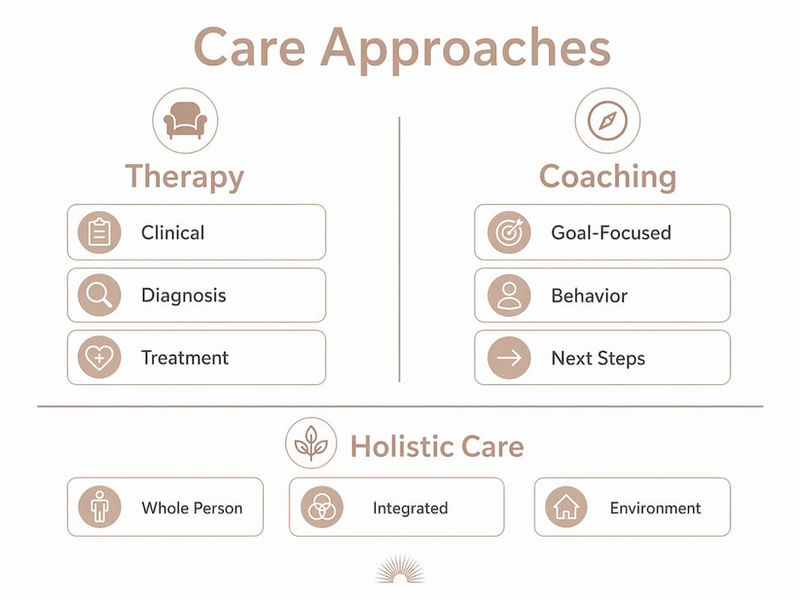
The therapy vs coaching difference is not about which is better. It is about what you actually need right now.
How do therapy, coaching, and holistic care complement each other?
These three approaches work best when they are combined with clear boundaries and a sensible sequence. Clinical distress must be stabilized with therapy before layering coaching or other practices on top. The reason is physiological. When the nervous system is dysregulated by trauma, severe anxiety, or depression, the brain cannot absorb skill-building or habit formation effectively. Therapy creates the stability that makes other work possible.
Once that foundation is in place, a combined care plan might look like this:
Start with therapy to address the clinical issue, stabilize mood, and build coping skills.
Add coaching once daily functioning is restored, to work on specific goals like career transitions, relationship patterns, or productivity.
Integrate holistic practices throughout, such as mindfulness, nutrition support, or movement, to reinforce both the clinical and coaching work.
Reassess regularly with each provider to confirm roles remain clear and progress is happening.
Successful outcomes depend on clear role boundaries between clinical treatment and performance coaching. Mixing roles without those boundaries causes stalled progress. A coach who starts addressing trauma, or a therapist who shifts into life coaching without flagging the change, creates confusion for the person receiving care.
Pro Tip: If you are working with both a therapist and a coach at the same time, tell each provider about the other. Shared awareness prevents overlap and keeps your care coordinated.
The integrative therapy coaching model works well for adults managing moderate stress who want both clinical support and practical forward momentum. It is not the right fit when someone is in acute crisis. In that case, therapy alone comes first.
What should you consider when choosing between these options?
Daily functioning is the most reliable filter. Experts emphasize daily functioning as the safest self-check for deciding between therapy and coaching. Ask yourself: Is my sleep significantly disrupted? Am I struggling to meet basic work or relationship responsibilities? Am I avoiding things I used to manage without much effort? If the answer to any of these is yes, therapy is the right starting point.
If your daily functioning is intact and you want to move forward on a goal, coaching fits better. The benefits of coaching show up most clearly when someone is ready to act, not when they are still trying to stabilize. Coaching works on accountability, habits, and practical tools. It is not designed to process grief, treat anxiety disorders, or work through childhood trauma.
When choosing a holistic care approach, consider these factors:
Your preference for integration. Do you want to address lifestyle, nutrition, and mental health together rather than separately?
Your current clinical status. Holistic care works alongside therapy, not instead of it, when a clinical condition is present.
Provider credentials. Credentialing varies widely among holistic providers. Ask specifically about training, certifications, and whether the provider works with licensed clinicians when needed.
Cost and time. Holistic care is rarely covered by insurance. Factor in session length, which tends to be longer than standard therapy appointments.
A common mistake is trying to self-diagnose which type of care you need. Starting with safety and stabilization is always the right first move when you are unsure. If there is any chance a clinical condition is present, a licensed therapist or psychiatrist should assess you first.
Pro Tip: When you contact a new provider, ask directly: “Do you treat clinical mental health conditions, or do you focus on goals and performance?” Their answer tells you immediately whether they are the right fit.
What can you expect in a therapy, coaching, or holistic care session?
Knowing what actually happens in each type of session removes a lot of the anxiety around starting. Here is what each path typically looks like in practice.
What a therapy session looks like
The first appointment is usually a clinical intake. The therapist gathers your history, current symptoms, and functioning level. From there, they may use a formal diagnostic process to identify a condition. Treatment typically follows evidence-based protocols like CBT, dialectical behavior therapy (DBT), or EMDR for trauma. Sessions run 45–55 minutes and often happen weekly, especially at the start. Progress looks like reduced symptoms, improved coping, and restored daily functioning.
What a coaching session looks like
Coaching sessions start with goal clarification. The coach helps you define what you want to achieve and builds a plan around it. Sessions are collaborative and forward-focused. There is no diagnostic process. The coach tracks your progress between sessions and holds you accountable to the steps you agreed to take. Sessions can be weekly or biweekly and often include practical tools like habit trackers, reflection prompts, or structured check-ins.
What a holistic care session looks like
Holistic psychiatric assessments tend to be longer and more comprehensive than standard therapy intakes. The provider maps biological, environmental, and social variables before any treatment begins. That detailed intake provides clarity and distinguishes holistic care from traditional therapy from the very first appointment. A personalized holistic treatment plan might include a combination of therapy, nutritional guidance, movement recommendations, mindfulness practices, and, when appropriate, medication. Progress is measured across multiple domains, not just symptom reduction.
Key Takeaways
Choosing the right care path depends on your current functioning, your goals, and the credentials of the provider you work with.
Point | Details |
Therapy requires licensure | Only licensed therapists can diagnose and treat clinical mental health conditions. |
Daily functioning is the key filter | Compromised sleep, work, or relationships signals that therapy should come first. |
Coaching builds on stability | Coaching works best after clinical distress is stabilized, not during it. |
Holistic care integrates multiple domains | It combines clinical and lifestyle approaches and is not a replacement for therapy when a diagnosis is present. |
Role clarity drives outcomes | Clear boundaries between provider roles prevent stalled progress and confusion. |
What I’ve learned from watching people choose the wrong door first
People often arrive at coaching or a wellness retreat when what they actually needed was a therapist. I have seen this pattern enough times to say it plainly: the wrong door is not a personal failure. The care landscape is genuinely confusing, and most people have no map for it.
What I find most useful is the functioning check. Not “how bad do I feel?” but “what am I not doing that I used to do?” That question cuts through the noise faster than any self-assessment quiz. When someone stops cooking, stops returning calls, or stops sleeping through the night, that is a clinical signal. It is not a coaching opportunity.
The other thing I want to say clearly: combining approaches is not a sign of weakness or indecision. The most grounded people I know use therapy for depth, coaching for direction, and integrative practices for daily maintenance. The key is knowing which one is doing which job. When those roles blur, progress stalls. When they are clear, the work compounds.
My honest recommendation is to start with the question of safety, not preference. If you are not sure whether you need clinical support, assume you do and get assessed. A good therapist will tell you if coaching is actually the better fit. A good coach will refer you out if clinical issues surface. The types of practitioners available today are more varied than ever. That is a good thing. Use it.
How Spine helps you find the right support
Figuring out whether you need a therapist, a coach, or a provider who integrates both is hard when the options are scattered across different platforms, directories, and recommendation networks.

Spine is an AI-powered platform that helps you find the right support before your first appointment. You describe what you are dealing with in your own words, and Spine matches you with therapists, coaches, and integrative care providers across conventional care, alternative approaches, or both combined. There is no diagnosis, no pressure, and no single ideology pushed on you. Spine is available worldwide on iOS, Android, and Web in 175 countries, in English, German, and Spanish. If you are ready to find a qualified provider who fits your actual situation, Spine is a clear and practical place to start.
FAQ
What is the main difference between therapy and coaching?
Therapy diagnoses and treats clinical mental health conditions using licensed, evidence-based methods. Coaching focuses on goal setting, behavior change, and accountability without diagnosing or treating illness.
Is holistic care the same as alternative medicine?
No. Holistic care integrates conventional clinical methods like CBT or medication with complementary practices such as nutrition and mindfulness. It targets root causes across biological, psychological, and social domains.
When should I choose therapy over coaching?
Choose therapy when daily functioning is significantly compromised, such as disrupted sleep, difficulty working, or strained relationships. Coaching is appropriate once clinical distress is stabilized.
Can I use therapy and coaching at the same time?
Yes, but clear role boundaries between providers are required. Mixing clinical treatment and performance coaching without defined roles leads to stalled progress and confusion.
How do I know if a holistic care provider is qualified?
Ask directly about their training, certifications, and whether they collaborate with licensed clinicians. Credentialing varies widely in the holistic care field, so specific questions matter more than general titles.
Recommended
About Spine App
Spine App is a free life companion app for your health: it connects you with real practitioners – conventional, holistic or both – lets you book sessions directly, and checks in afterwards to ask what helped.
Written by the Spine App Editorial Team.
Spine App is free: find people who help and a community that gets it. Get it on App Store · Google Play