Types of Wellness Platforms for Practitioners: 2026 Guide
- astauche6
- 5 days ago
- 9 min read

Seven distinct types of wellness platforms exist for practitioners and people seeking care: marketplace/discovery platforms, practice-management systems, telehealth platforms, care-coordination hubs, events and booking platforms, membership/course platforms, and CRM/analytics tools. For someone who wants a single companion app to find practitioners, sessions, and events across both conventional and holistic care, Spine App is the clearest starting point.
The main types at a glance:
Discovery/marketplace platforms — connect people to practitioners and sessions
Practice-management and telehealth systems — run the operational side of a practice
Events, booking, collaboration, and CRM platforms — handle promotion, coordination, and retention
Table of Contents
What each type of wellness platform actually does
Each platform category solves a different problem. Knowing the difference saves you from signing up for the wrong tool.
Platform Type | Discovery | Booking | Secure Messaging | Marketing/CRM |
Marketplace/Discovery | ✓ | ✓ | Limited | Limited |
Practice-Management (PMS) | ✗ | ✓ | ✓ | Partial |
Telehealth | ✗ | ✓ | ✓ | ✗ |
Care-Coordination Hub | ✗ | ✗ | ✓ | ✗ |
Events & Booking | ✓ | ✓ | Limited | ✓ |
Membership/Course | Partial | ✓ | ✗ | ✓ |
CRM & Analytics | ✗ | ✗ | ✗ | ✓ |
Marketplace/discovery platforms list practitioners and sessions so people can search by modality, location, or need. Core features include search filters, practitioner profiles, booking, and user reviews.
Practice-management systems (PMS) handle scheduling, intake forms, invoicing, session notes, and client records. They are built for the practitioner’s workflow, not the client’s search experience. Platforms like Practice Better serve over 50,000 practitioners and combine EHR, client portals, and payment processing in one place.

Telehealth platforms deliver video or asynchronous care. They prioritize HIPAA-compliant video, encrypted messaging, and documentation, but rarely offer public discovery.
Care-coordination hubs let practitioners from different disciplines share brief notes, referral letters, and treatment summaries. Secure messaging features in these platforms include two-way encrypted chat tied to client records and configurable response windows.
Events and booking platforms let practitioners host workshops, retreats, and group sessions. They provide multi-channel marketing, waitlist management, variable pricing (deposits, installments), and automated reminders across the attendee lifecycle to reduce admin burden.
Membership and course platforms package practitioner expertise into on-demand content, programs, and retreats. Discovery is limited to the platform’s own audience.
CRM and analytics tools track client history, automate follow-ups, and report on retention. They rarely handle booking or clinical records directly.
When to pick each type — and when to skip it
Choosing the right model depends on whether your priority is finding care or running a practice.
Marketplace/discovery platforms suit anyone who wants to browse practitioners by specialty or location without a prior relationship. The tradeoff is that the platform owns the client relationship, and practitioners have limited control over how their profile appears.
Practice-management systems are the right choice when a practitioner needs to manage scheduling, billing, and session notes in one place. A record that aggregates other providers, medications, and active treatment plans reduces repetitive intake and supports continuity of care across visits. The learning curve is steeper, and setup typically takes one to four weeks.
Best for: Solo practitioners and small group practices that want full operational control
Watch out for: High monthly fees and data portability restrictions
Telehealth platforms work well for practitioners whose clients are geographically dispersed or prefer remote sessions. They are not built for discovery.
Care-coordination hubs matter most when a client is seeing multiple practitioners across modalities. Integrated platforms reduce the administrative burden compared with disjointed systems and help practitioners keep their own voice in client communications.
Events and booking platforms fit practitioners who run workshops, retreats, or group programs. Wellness-only marketplaces often provide host dashboards, promotional widgets, attendee messaging, and sponsorship matching alongside ticketing.
Membership/course platforms suit practitioners who want to monetize expertise at scale, but they offer little for someone seeking a practitioner for one-on-one care.
CRM/analytics tools are add-ons, not standalone solutions. They work best when layered on top of a PMS or booking platform.
Security, cross-practitioner collaboration, and why they matter
Prioritize platforms that explicitly state HIPAA compliance, end-to-end encrypted messaging, and written release-of-information workflows before sharing any client information.
Effective cross-practitioner collaboration relies on secure, encrypted messaging hubs and standardized referral processes. The barrier between holistic and conventional practitioners is often a lack of shared language and templates; using standard referral letters and decision aids increases coordination quality. A practical standard for busy cross-discipline peers is a three-sentence coordination note: who you are, why you are contacting, and the one action requested.
Client communication best practices recommend establishing preferred communication channels, response times, and what counts as urgent during initial orientation. Telling clients which channel to use (portal vs. phone), your typical response window, and what warrants an urgent call reduces friction for everyone.
Pro Tip: When messaging a practitioner across disciplines, keep your note to three sentences: your name and role, the reason for contact, and one specific question or request. Anything longer often goes unanswered.
Security signals worth checking: a clear privacy policy that names data residency, explicit HIPAA Business Associate Agreement (BAA) availability, encryption stated for data in transit and at rest, and a documented authorization workflow before records are shared.
How to choose a wellness platform: a practical checklist
Ask these questions before committing to any platform.
Does the platform state HIPAA compliance and offer a BAA?
Who owns the client relationship — you or the platform?
Can you export your data in a standard format if you leave?
Does it integrate with your calendar, payment processor, and EHR?
What are the cancellation terms and notice period?
Is secure messaging included, or is it an add-on?
Does it support the types of practitioners you work with or want to find?
Red flags to watch for:
Vague or missing privacy policy
Mandatory revenue share with no clear benefit to you
No secure messaging or only unencrypted email
Locked data export formats that prevent migration
During a trial, test the full booking flow, send a non-urgent message to a practitioner, attempt to export a record, and simulate an event sign-up. If any step is unclear or blocked, that is useful information before you commit.
Typical pricing and onboarding timelines
Platform Type | Typical Pricing Model | Typical Onboarding Time |
Marketplace/Discovery | Free listing + per-booking fee or subscription | 1–3 days |
Practice-Management | Monthly/annual subscription | 1–4 weeks |
Telehealth | Per-session fee or monthly subscription | 3–7 days |
Care-Coordination Hub | Subscription or freemium | 3–7 days |
Events & Booking | Per-ticket fee + subscription | 3–5 days |
Membership/Course | Revenue share + monthly fee | 1–3 weeks |
CRM & Analytics | Monthly subscription | 1–2 weeks |
Discovery listings are the fastest to set up, often live within a day or two. Full practice-management migration — importing client records, configuring intake forms, connecting payments — realistically takes one to four weeks. Event platforms sit in the middle: the technical setup is quick, but building an audience and testing automated reminders takes longer.
Pricing shapes vary widely. Subscription models give predictable costs; per-booking or revenue-share models lower the upfront barrier but can become expensive at volume. Always calculate your projected monthly cost at your actual booking volume, not the minimum.
How Spine App fits into this picture
Spine App sits in the discovery and companion category, with features that go beyond a standard directory.
Discovery across care paths: Users describe what they need in their own words. Spine App guides them to practitioners, sessions, events, and resources matched to their situation, across conventional care, holistic and alternative care, or both.
No practice-management overhead: Spine App is not a PMS or EHR. It does not replace a practitioner’s scheduling or billing system. It works alongside those systems as the discovery layer.
Event and session discovery: People can find group sessions, workshops, and events, not just one-on-one appointments.
Available everywhere: Live on iOS, Android, and Web in 175 countries, with priority focus on the US market.
A person new to holistic care, for example, can describe what they are experiencing, receive practitioner suggestions across modalities, and book a first session without knowing in advance whether they need a therapist, a coach, or a movement practitioner. A solo practitioner benefits from discovery reach without giving up control of their own scheduling or client records. For guidance on evaluating practitioner credentials before booking, Spine App’s blog offers practical trust-signal guidance.
Ready to try a companion app? Start here
Follow these steps in 15–30 minutes to evaluate whether a discovery companion app fits your needs.
Create a free account on Spine App (iOS, Android, or web).
Search for two practitioners or events using your own words, not category labels.
Save both to your profile and note how long the search took.
Test the booking flow for one session or event.
Review the privacy settings and data export options.
Send a non-urgent message or inquiry to one practitioner.
Check notification settings and confirm you received a confirmation.
Early success signals: you found a relevant practitioner within two minutes, the booking flow completed without redirecting you to a third-party site, and you could locate the privacy policy in under 30 seconds. If any of those three steps failed, note it and contact support before committing further.
Key Takeaways
The most practical approach to choosing a wellness platform is to match the platform type to your actual job: discovery, practice operations, or both.
Point | Details |
Seven platform types exist | Marketplace, PMS, telehealth, care-coordination, events/booking, membership/course, and CRM each solve a different problem. |
Security signals matter | Confirm HIPAA compliance, encrypted messaging, and a BAA before sharing any client information. |
Onboarding time varies widely | Discovery listings go live in 1–3 days; full PMS migration takes 1–4 weeks. |
Test before committing | During any trial, test booking, messaging, data export, and privacy settings. |
Spine App for discovery | Spine App guides people to practitioners, sessions, and events across conventional and holistic care paths in 175 countries. |
What actually matters when choosing a companion app
Most people approach platform selection as a feature checklist. That misses the more important question: does this platform respect the relationship between a person and their care?
Privacy and clear communication boundaries are not nice extras. A platform that obscures its data policy or makes it hard to export your records is telling you something about how it views your autonomy. The same applies to practitioners using platforms to coordinate care. The three-sentence coordination note standard exists because brevity signals respect for a colleague’s time and keeps the focus on the client, not the admin.
What I find underestimated is how much the discovery experience shapes a person’s first impression of care itself. A confusing search, a broken booking flow, or a practitioner profile with no clear information can stop someone from seeking help they genuinely need. That is the real cost of a poorly chosen platform, and it rarely shows up in feature comparison tables.
Spine App: a personal companion for finding the right care
Most platform types described in this article are built for practitioners running a business. Spine App is built for the person looking for care.
[
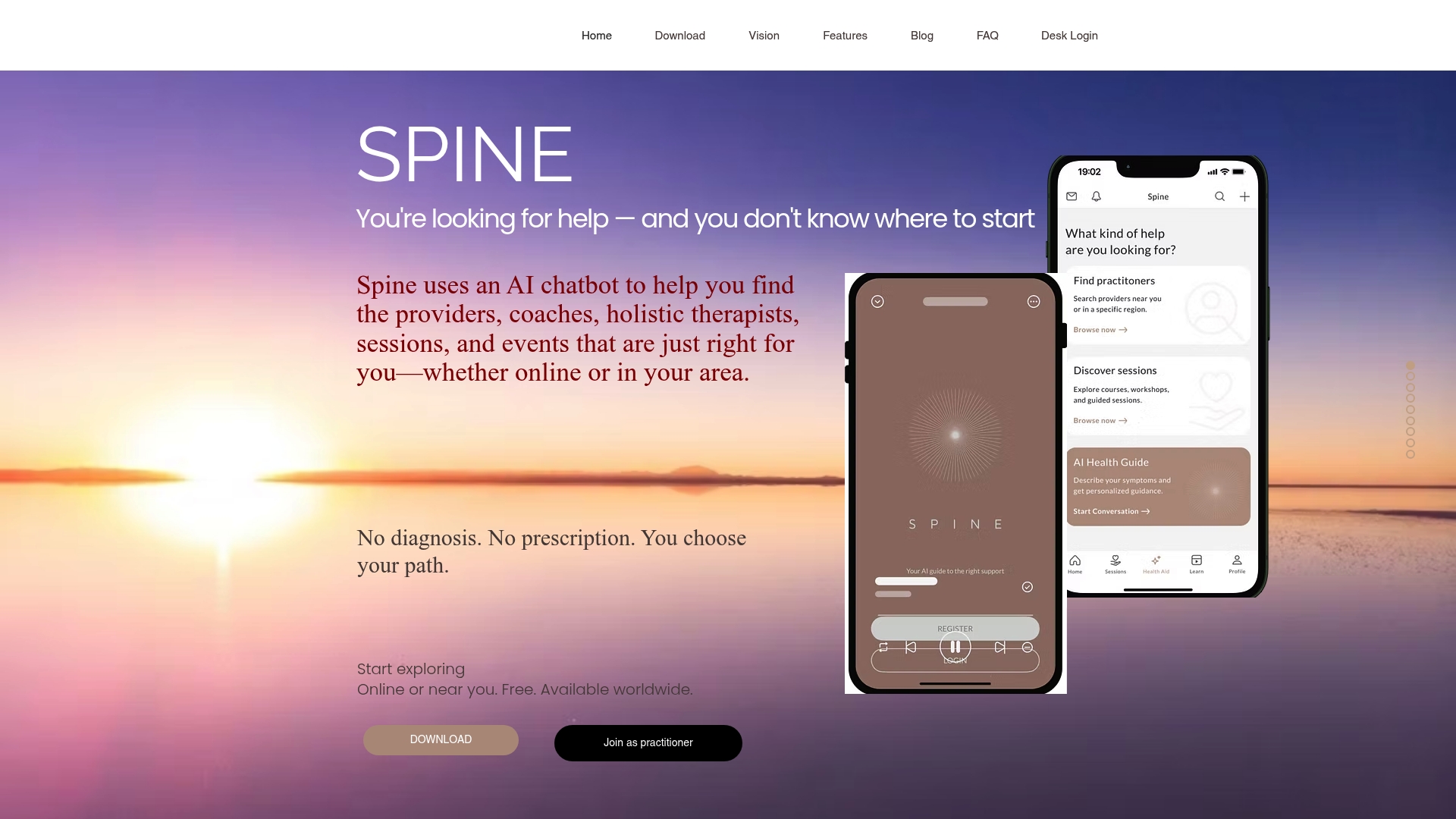
When you are not sure whether you need a therapist, a coach, a movement class, or something else entirely, Spine App lets you describe what you are experiencing and guides you to matched practitioners, sessions, and events across conventional and holistic care paths. No category expertise required. No directory to scroll through. The app is free to try on iOS, Android, or web, and it works in the US and across 175 countries.
Start with Spine App by searching for a practitioner or an upcoming event in your area. It takes less than two minutes to see what is available for your situation.
Useful sources
Co-creation of an evidence-based toolkit to facilitate communication between conventional and complementary healthcare practitioners — Elsevier, European Journal of Integrative Medicine
Secure client messaging features — MyWellOps
Client communication best practices for wellness practitioners — Stillpoint
When a client mentions they’re seeing another practitioner — Stillpoint
Host events and workshops: features overview — WellnessLiving
Host wellness events — Bloomy
FAQ
What are the main types of wellness platforms for practitioners?
The seven main types are marketplace/discovery platforms, practice-management systems, telehealth platforms, care-coordination hubs, events and booking platforms, membership/course platforms, and CRM/analytics tools. Each serves a different function, from client discovery to operational management.
Does a discovery app replace a practice-management system?
No. A discovery companion like Spine App helps people find practitioners and sessions; a practice-management system handles scheduling, billing, and clinical records. Most practitioners use both, with the PMS running the practice and a discovery platform handling new client reach.
What security features should I look for on any wellness platform?
Look for explicit HIPAA compliance, a Business Associate Agreement (BAA), end-to-end encrypted messaging, and a documented release-of-information workflow before any client data is shared across practitioners.
How long does it take to get started on a new wellness platform?
Discovery listings typically go live within 1–3 days. Full practice-management migration, including client records and intake forms, realistically takes 1–4 weeks depending on the volume of existing data.
Can Spine App help me find both conventional and holistic practitioners?
Yes. Spine App guides people across three care paths: conventional care, holistic and alternative care, or both combined, without ranking one above the other. It is available on iOS, Android, and web in 175 countries.
Recommended