
Start With One Sentence: Divorce Support Resources That Find Help Fast
Updated: 5 hours ago

The best first move is matching your immediate need to the right format, not browsing every provider you can find. If you’re raw and need to process feelings, a peer group or individual therapist usually helps fastest. If you’re untangling custody logistics with an ex, co-parenting counseling or a court-affiliated class is the better fit. The app lets you search by situation instead of scrolling bios, which is often the fastest way through either problem.
TL;DR:
Support options should be chosen based on your primary goal, whether it is emotional regulation, co-parenting, or legal logistics, to avoid unnecessary trial and error.
Cost-effective resources like university clinics, nonprofit agencies, and court-approved classes often offer sliding-scale or free services more accessible than typical directories suggest.
Co-parenting counseling generally costs between $100 and $250 for six to twelve sessions and should be kept separate from couples therapy to focus on parenting functions.
When searching for support, starting with a clear, one-sentence goal helps filter options efficiently and prevents distraction by less relevant profiles.
Using platforms like Spine App enables situation-based filtering, rapidly connecting you with providers that match your specific needs, modality preferences, and budget constraints.
Table of Contents
Where to Find Divorce Support Resources Right Now
Divorce support resources fall into a handful of formats, and each one solves a different problem. Knowing which one matches your situation saves weeks of trial and error.
Peer support groups: Drop-in groups offer immediate, no-commitment venting and validation. Structured multi-week programs, like DivorceCare’s 13-week video-based series that more than a million people have completed, add curriculum and accountability on top of peer connection.
Therapist-led group therapy: Combines peer support with clinical guidance, useful if grief or anxiety feels unmanageable alone.
Individual therapy: Best for processing trauma, anxiety, or identity loss privately, with a licensed clinician tracking your progress over time.
Coaching: Practical, forward-looking, and often cheaper than therapy. Good for rebuilding routines, dating again, or career decisions.
Moderated online groups and teletherapy: Lower the barrier to entry for people in the chaotic early weeks, when leaving the house feels like a project.
Access points include community centers, church-run groups, therapist directories, employee assistance programs, and apps that combine several formats in one search.
How Do I Choose the Right Kind of Divorce Support?
Start by naming your primary goal, not your diagnosis. Are you trying to regulate emotions, coordinate parenting with an ex, or handle legal and financial logistics? Each points to a different provider type.
Emotion-focused goal → individual therapist, grief counselor, or a peer support group.
Child-focused or co-parenting goal → co-parenting counselor or a court-affiliated parenting class.
Logistics-heavy goal (finances, housing, legal steps) → a coach or advisor who works specifically with separating clients, paired with a lawyer for anything binding.
Before you commit to a first session, ask a few direct questions: How much experience do you have with divorce specifically? What does a typical session look like? Do you offer sliding-scale fees? If it’s co-parenting work, have you worked with court orders before?
Pro Tip: Treat the first session as an interview, not a commitment. A provider who can’t answer a direct question about fees or experience in one sentence is worth reconsidering.
Watch for red flags: promises of a quick fix, a general therapist claiming deep co-parenting expertise with no track record, or fee structures that stay vague until after your first visit.
What Free or Low-Cost Divorce Support Options Exist?
Cost stops a lot of people before they start, but sliding-scale and free options are more common than most directories make obvious.
University-affiliated counseling clinics, where supervised trainees see clients at reduced rates.
Nonprofit family-service agencies, often with sliding scales tied to income.
Court-affiliated parenting classes, which are frequently free or low-cost since many are court-approved and satisfy education requirements directly.
Church or community-run divorce recovery groups, usually free or donation-based.
Moderated online peer groups, which cost nothing beyond time.
The tactic that works: ask about sliding-scale pricing upfront, before you describe your situation in detail. Search terms like “training clinic” or “court-approved parenting class” surface options that generic directory searches bury. Spine App’s breakdown of sliding-scale and telehealth options is a useful starting point if you want typical price ranges before you call anyone.
What Is Co-Parenting Counseling and What Does It Cost?
Co-parenting counseling is not couples therapy. The goal is functional parenting between two people who are no longer together, not reconciliation, and family-counseling experts stress keeping the two processes separate so sessions don’t drift into relationship repair.
Sessions typically run $100 to $250, with many counselors offering sliding-scale rates, and a typical course consists of six to twelve sessions rather than open-ended treatment.
Courts sometimes order co-parenting counseling directly, especially in high-conflict custody cases.
Court-affiliated programs can provide documentation the court accepts as proof of completion.
Ask any prospective counselor whether they’ve worked with court orders before. Not all clinicians who advertise “family therapy” have that specific experience.
How Do You Stop Feeling Paralyzed by Provider Directories?
Open a typical directory search for “divorce therapist” and you’ll get forty bios, half of them listing ten specialties each. Anxiety, trauma, couples, families, career transitions, grief. None of them tell you who actually fits your exact situation, and after the tenth profile most people close the tab and do nothing.
The fix is starting from your situation, not the list. That means naming the immediate job to be done before you look at a single profile: regulate emotions, stabilize co-parenting, or handle logistics.
Name your immediate goal in one sentence before opening any directory.
Pick a format that matches it: short-term co-parenting work, ongoing individual therapy, or a coaching sprint.
Filter for practical constraints first, availability, cost, online versus in-person, before reading a single bio for personality fit.
Scan reviews specifically for role-fit language, not overall star ratings.
Combining approaches deliberately, a co-parenting counselor alongside a somatic therapist for anxiety, or acupuncture alongside individual therapy for sleep and stress, is often more useful than picking one lane and hoping it covers everything. Spine App’s situation-first search filters by modality, cost, and availability from the start, so you’re narrowing a list of thirty down to three before you read a single bio.
Pro Tip: Write your one-sentence goal down before you search. It keeps you from getting pulled toward the most polished bio instead of the most relevant one.
What Should You Do in the First Week?
Small, repeatable actions do more than any single big decision in the early weeks. Mental Health America’s guidance on coping with separation points to routines, sleep, and avoiding alcohol or drugs as coping tools, along with reinvesting in a hobby that’s entirely yours.
Keep a consistent sleep and meal schedule, even when nothing else feels normal.
Avoid using alcohol or other substances to manage the harder nights.
Pick one hobby or activity that has nothing to do with your ex or the divorce.
If children are involved, keep routines and discipline consistent across both households, and reassure them directly that the situation isn’t their fault.
Three concrete moves this week: contact one support option (a group, a therapist, a coach), schedule an actual intake appointment rather than “looking into it,” and pick one small routine, a morning walk, a set bedtime, to protect no matter what.
Legal Support Resources and How They Complement Emotional Support
Legal support and emotional support solve different problems, and treating them as the same thing usually backfires. A lawyer negotiates custody terms, asset division, and filing deadlines. A therapist or coach helps you regulate the stress those negotiations create. Neither one substitutes for the other.

Legal aid organizations, family law clinics, and court self-help centers exist specifically for people who can’t afford full representation, and many family courts publish lists of low-cost legal clinics alongside their parenting-class requirements. It’s worth calling your local courthouse directly, since availability and eligibility rules vary by jurisdiction.
Where the two overlap matters most: high-conflict negotiations. A lawyer focused purely on legal strategy won’t flag that you’re making decisions from exhaustion or fear, and a therapist can’t advise you on custody law. Bringing a coach or counselor into the loop, even briefly, before a major legal meeting can change how clearly you show up to it. Some co-parenting counselors work directly alongside family attorneys for exactly this reason, coordinating so legal strategy and emotional stability aren’t pulling in opposite directions.
If you’re mid-negotiation and flooded with anxiety, that’s a signal to loop in emotional support, not push through alone. Legal deadlines don’t wait for you to feel ready, which is precisely why the two supports need to run in parallel rather than one after the other.
Resources for Children and Teenagers Affected by Divorce
Kids process divorce differently depending on age, and support resources reflect that. Younger children often benefit from play-based therapy or family sessions that use concrete language rather than abstract discussion of feelings. Teenagers frequently respond better to individual counseling where they get privacy from both parents, plus peer support groups specifically for teens of divorced parents, which many school counseling offices can point you toward.
School counselors are an underused resource here. They see how a child is functioning day to day and can flag concerns before they show up as bigger problems at home. Many schools also run small peer groups for students navigating a parents’ divorce, often at no cost.
Family therapists who specialize in divorce transitions can work with the whole family unit or with children individually, depending on what’s needed. The consistency piece matters most: children do better when both households keep similar routines, similar rules, and a similar tone about the other parent, even when the adults are struggling to manage that themselves.
If a teenager withdraws sharply, their grades drop suddenly, or a younger child regresses in ways that don’t improve over several weeks, that’s worth a referral to a child-focused therapist rather than waiting it out. Divorce is disruptive for kids at every age, but the specific kind of support that helps looks different at seven than it does at sixteen.
Crisis Support and Emergency Help Resources
If you or someone in your household is in immediate danger, or you’re having thoughts of self-harm, call or text 988 to reach the Suicide and Crisis Lifeline, available 24 hours a day across the United States. This isn’t a resource to save for later. It exists precisely for the nights when everything else feels too far away.
Divorce raises the stakes in specific ways. Financial stress, sudden isolation, and disrupted sleep can intensify depression or anxiety that was manageable before. If a safety plan is in place, follow it. If it isn’t, a crisis line, an emergency room, or a same-day appointment with a primary care provider are all valid starting points; you don’t need a referral to walk into an emergency room.
Domestic violence adds another layer. If safety is a concern in your household, the National Domestic Violence Hotline offers confidential support and can help with safety planning specific to leaving a relationship. Local shelters and legal advocates often work together on these situations, so one call frequently opens several doors at once.
None of this replaces ongoing therapy or a support group, but crisis resources exist for the moments before you can get to either one. Save the numbers now, before you need them at 2 a.m.
Cultural or Faith-Based Divorce Support Options
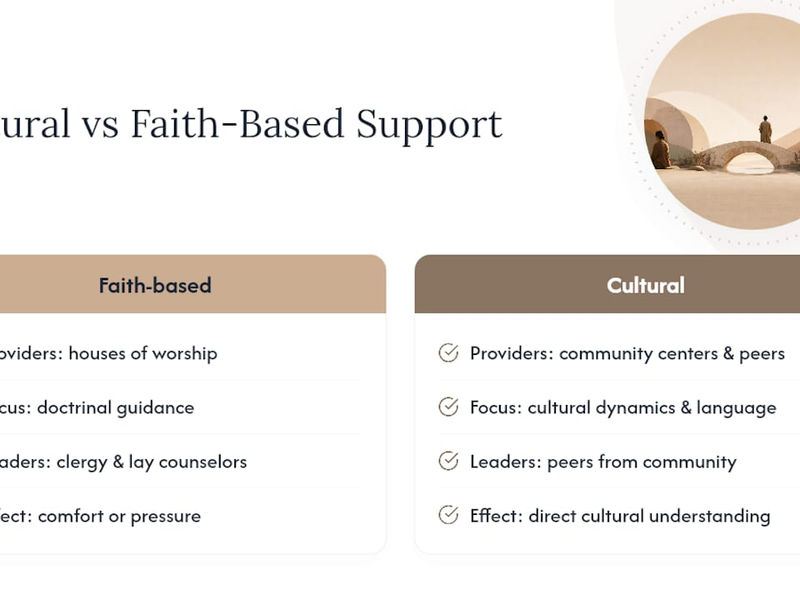
Many people prefer support that reflects their cultural background or religious tradition, and that preference is worth honoring rather than working around. Churches, synagogues, mosques, and temples frequently run divorce support groups led by clergy or trained lay counselors who understand both the emotional and doctrinal dimensions of separation within that tradition.
Faith-based groups can offer something secular support sometimes misses: a shared framework for questions like forgiveness, remarriage, or what the community expects going forward. For some, that framework is a source of real comfort. For others, particularly if a faith community’s stance on divorce feels judgmental, it can add pressure rather than relieve it. Both reactions are common, and neither is wrong.
Cultural background shapes support needs too. Extended-family involvement, expectations around gender roles after separation, or language barriers with English-only providers all affect what “the right support” looks like. Community centers organized around a specific ethnic or immigrant community sometimes run informal peer groups that address these dynamics directly, in ways a general therapist without that background may not.
The practical move is the same one that applies everywhere else in this guide: name what you actually want from support, whether that’s doctrinal guidance, language match, or simply people who understand your specific cultural context, before searching. That single filter narrows a broad search fast.
From Overwhelmed Scrolling to One Booked Intake
A reader once described spending an evening scrolling through forty therapist bios, each one listing a dozen specialties, and closing the laptop no closer to a decision than when she’d opened it. What changed things wasn’t a better directory. It was writing down one sentence: “I need help managing anger during custody handoffs.” That single sentence turned an impossible list into three realistic options, and she booked an intake the same week. This app exists for exactly that moment, when the goal is clear but the path to it isn’t.
Try Spine App to Search by Situation, Not by Specialty List
This platform is an alternative to scrolling through generic directories: you describe your situation once, and it surfaces therapists, coaches, and holistic practitioners filtered by modality, cost, and whether you want online or in-person sessions.

That matters most in the exact moment this guide has walked through: you know you need help with co-parenting conflict, or grief, or just rebuilding a daily routine, but you don’t have the energy to read fifty bios to find who fits. A guided search for “divorce recovery” or “co-parenting counselor” narrows that list immediately, and you can filter further for sliding-scale pricing or online-only sessions if cost or logistics are a concern. Providers range across both conventional options, licensed therapists, EMDR specialists, cognitive behavioral therapy practitioners, and holistic approaches like acupuncture, breathwork, or somatic experiencing, depending on what actually fits how you process stress. Once you find someone who looks right, you can review their profile and reach out directly. Start with one clear sentence about what you need, then run a guided search on Spine App to see who actually matches it.
This article is general information, not a substitute for advice from a qualified doctor. Consult a qualified healthcare professional about your own circumstances before acting on anything here.
Sources
FAQ
Where can I find free divorce support?
Church-run divorce recovery groups, court-affiliated parenting classes, and nonprofit family-service agencies commonly offer free or donation-based support. University counseling clinics staffed by supervised trainees also charge little to nothing.
What is the 10-10-10 rule for divorce?
Definitions vary depending on the source, and no single authoritative version applies universally. If you’ve seen it referenced for a specific financial or custody context, check that source directly rather than relying on a general definition.
What should I do if I can’t afford to get divorced?
Look into legal aid organizations, family law clinics, and court self-help centers, many of which offer reduced-fee or free services based on income. Court self-help centers can also walk you through filing paperwork without a full attorney retainer.
What can I do to cope with struggling after a divorce?
Keep basic routines like sleep and meals consistent, avoid using alcohol or drugs to manage difficult moments, and reinvest in a hobby that’s entirely your own, all steps Mental Health America recommends for post-separation recovery.
How much does co-parenting counseling cost?
Sessions typically run $100 to $250, with sliding-scale options common, and a typical course runs six to twelve sessions rather than open-ended treatment.
Is co-parenting counseling the same as couples therapy?
No. Co-parenting counseling focuses on functional parenting logistics between separated parents, while couples therapy focuses on the relationship itself, and mixing the two goals tends to slow progress on both.
How does Spine App help with finding divorce support?
The app lets you search by your specific situation, then filter results by modality, cost, and online or in-person availability, which narrows a long directory list down to a handful of realistic matches.
Recommended
Download Spine App now:
Android: Get it on Google Play
About Spine App
Spine App is your life companion for body, mind and soul. The app connects people with providers, sessions, events and podcasts — conventional, holistic or both. Available in 175 countries and three languages. Founded by Sylvia Leifheit.
Written by the Spine App Editorial Team.
